by Coffee Kevin | Feb 24, 2011 |
Water is the number one subject people ask about. Water is the solvent that brings for the oil from the grounds. Without water, there’s no coffee. Learning about water and how to view it helped me enormously to brew better coffee. As in most things coffee, there are lots myths surrounding water. I want this to be short and sweet. Here’s my quick opinionated practical guide to brew great coffee.
 Hard Water
“Hard water won’t extract because it’s already too full of minerals.”I hear it all the time. Don’t think of water as absorbing coffee oils. Think salad dressing. Oil and water don’t mix. Think of heated water being a solvent that removes coffee oil from the grounds and they get mixed into the hot water, making the beverage known as coffee. Also, when water is heated the minerals go into suspension. They are virtually unimportant during brewing. What minerals do is add taste. The reason not to use highly mineralized water is they risk adding a flavor that competes with or clashes with your coffee flavor. If that’s not reason enough, hard water suspended during heating, cools and hardens on the insides of your coffeemaker’s plumbing. It doesn’t take much to clog your coffeemaker’s arteries and interfere with the flow. This causes everything from substandard brewing temperatures, to slowing down brewing to simply halting the process. A coffeemaker manufacturer’s repairman once told me the majority of their service was simply calcium-choked coffeemakers.
If you have highly mineralized water, you should do the following: Drink some. If it tastes good, you can brew coffee with it. If the water doesn’t taste good, you shouldn’t brew with it because it will flavor your coffee, almost always it will taste bad. For bad tasting water use bottled water. For very hard water, you can choose. If you are willing to routinely be running vinegar or Urnex (a good coffeemaker cleaner) through your machine, and use fresh water (better still distilled or low-mineral bottled water) to rinse afterwards, you can continue to use hard water. But consider if your water is hard enough, you won’t save much by just switching to bottled water, compared to buying vinegar, coffeemaker cleaner and bottled water to rinse the machines.
Bottled Water
If you use bottled water, check to see that it is low enough in minerals to make a difference. Usually it is lower simply because most bottled water manufacturers do some filtration to make their products consistent… but not always. Some bottled waters are full of minerals and not even any softer (meaning lower in mineral content) than the hardest tap water. The most reliable waters for brewing coffee are so-called drinking water, which are usually highly filtered municipal waters. Most often, they are treated with reverse osmosis filtration, which all but eliminates minerals. Then, the water bottler adds some particles in controlled amounts, just enough to add ‘normal’ flavor – water with no minerals can taste ‘flat’. There are some excellent good-tasting bottled waters, both low in minerals and with good taste that are not r/o filtered, but they take a little patience to find.
Softened Water
Under no circumstances should you use softened water, meaning water that’s been treated with a home water softener. Actually, there is an exception – espresso machines sometimes benefit from softened water, but these are dedicated machines and it’s a special case. I’m still not certain I fully approve of it, but at least it qualifies as a possibility – with espresso. This is not true using drip, vacuum or press pots. Softened water is especially problematic with automatic drip machines, where softened water and ground coffee can combine to make gelatinous goo that will become stuck in your brew basket.
Softened water is virtually undrinkable anyway due to its elevated sodium content. I anticipate the question of alternate softening methods. To be honest, I don’t know, nor do I know if it’s been researched by anyone. I’m eager to learn if any tests have been done.
So, there are the coffee basics you need to brew great coffee minus the myths.
by Coffee Kevin | Feb 1, 2011 |
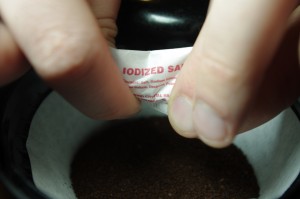
When Good Eats’ host Alton Brown did a coffee segment some years back I was surprised at how casual the man who claims to be food’s OCD poster child was about preparing a beverage I know to be among the most finicky and demanding of cooking arts. If his general demeanor convinced me that Mr Brown is not a devout coffee enthusiast, his advice that his special sauce for getting the best coffee taste was adding salt to the grounds sealed it. I was genuinely despondent over the segment. For one thing, it showed he either never saw or wasn’t convinced by my own appearances on Food where I attempted to evangelize good brewing techniques and attentiveness to the process. Second, I was horrified to see him suggest adding salt.
To Salt or Not
Salt is, according to food medical sages, a slow poison to health. I’m a philosopher when it comes to such warnings. I think a lot of living is eating and, after my early years as a strict food puritan, I came to take a common sense mix of good living and reasonable caution. I don’t smoke or drink heavily. I preach moderation in all things, including salt. By my reckoning a key to long life is learning not to be a health fanatic as worry appears to kill as quickly as the occasional wrong ingredient. So my objection to salt in coffee is not based upon health issues. I acknowledge that salt is not a killer in the amounts advised by Brown.
I’ve also heard food industry critics challenge Brown using the conflict of interest argument. They claim the Brown is funded by a major salt company and thus his views are tainted by his paycheck. Again, I say nay. I think Brown appears to me to be sincere in his beliefs. If I’ve learned one thing in writing about coffee, you’re going to find funding from those you generally agree with and who recognize that what you’re saying is what they want to help spread around. It isn’t always a conflict. It is more often the other way around. The people who want to fund you like you because you both generally agree. I think Brown likes salt and the salt companies simply know this, like this and make their investments accordingly. So, my objection has nothing to do with an impropriety.
I think Alton Brown is wrong, that’s all. Oh, is he right that adding salt to coffee affects the flavor? Yes, he is. But why? Salt is a taste desensitizer. It is roughly the same thing as advising eyeglass wearers to not clean their glasses before viewing their cable TV because it will help cover the artifacts present in video downloads. It’s actually a pretty fair analogy because salt softens the harshness in coffee – coffee that’s poorly brewed that is. Oh yes, it’s also coffee that’s low quality. This is what irks me. Brown, who counsels people to spend extra money and time seeking high quality seafood, meat and vegetables, suddenly offers coffee shortcuts to help hide the defects in inferior beans, and mistakes inherent in poor brewing practices and faulty equipment. Suddenly, the man who’s taught you to cook dinner as if you’re a chef in the most expensive Paris restaurant, is instructing you to brew coffee in a World War II-era Soviet worker’s kitchen. He’s doing all this during an age of comparative coffee bean greatness. I’m befuddled.
Now if I may move upwards from scolding Rachel Ray’s predecessor for a moment, let’s talk about what exactly salt accomplishes in brewing. Salt is a flavor de-hancer. When you go to the supermarket on a Saturday and the cute person handing out tiny wine samples offers you a cube of cheese to accompany it, it is to help the wine by cutting the harshness of a relatively young, inexpensive wine. No wine expert would consider having cheese before or during a wine tasting. More important no one whose spent a hundred dollars or more on a bottle would want to risk destroying their tongues ability to savor that extra fragrance and taste nuances they’ve paid top dollar for. If they do, I can help them save money.
Cheese is called “the winemaker’s friend” precisely because it deadens your taste buds. It may not hurt your experience, but at least know you are like the wealth rock star who learns from a former starlet’s autobiography that he bedded her down. He has no memory of the experience but it must have been wonderful. To me that’s a waste.
Salt does not heighten the flavor of most foods, but limits your ability to taste them. Once you learn this, you are likely to either save money by buying cheaper foods knowing you can reduce the off tastes, or you can begin to really savor them by reducing the salt and allowing your taste buds to really focus on their various flavor essences and aromas.
Ironically, in an age when coffee snobs smirk at seeing their social inferiors adding a dollop of cream to their cups, cream, especially the richer, fattier varieties, can arguably be called flavor enhancers rather than taste deadeners. The challenge here is that the corporate dairies customarily add sodium to cream, probably due to the assumption that a majority of their customers buy poor coffee and don’t know how to brew it.
I urge you to buy direct trade coffees grown by farmers known to your roaster, and brew those coffees within fourteen days of roasting, using the practices I’ve spent years learning and spreading. If you do all this right, you will end up with some of the most exotic and pleasurable aromas and flavors known to man. If you still want to sweeten or enrich them with sugar or cream, be my guest.
But I urge you with equal passion to spare the salt.