by Coffee Kevin | Jan 25, 2015 |
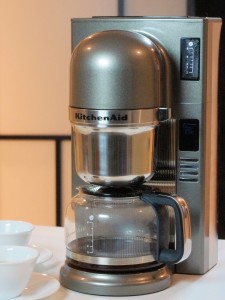 KitchenAid’s new 8-cup automatic drip Coffeemaker is proof that appliance manufacturers now take coffee making parameters as seriously as they do any culinary art. KitchenAid has long been a coffee innovator, with high build quality and within reasonable price points. This new model has literally been years in the making.
I visited them during summer 2012, during which time their four person design team held a therapy session, where I lay back and told them everything missing from most coffeemakers. Just kidding about that part, but suffice it to say, I left feeling unburdened and they went to work building it.
Sure enough, they brought it to this year’s CoffeeCon San Francisco and Los Angeles events. I recall making a beeline to taste a cup. It was good enough that I requested a model for my long-term at-home tests, from which I made review judgments.
This KitchenAid model has several important features:
• Pre-infusion stage. It dribbles a small amount of water, pauses to allow ultra fresh coffee grounds to get wet and exhale their carbon dioxide.
• Intermittent brewing throughout the brewing process, just like you instinctively do using a manual drip coffeemaker. We’ll talk more about this in in a moment.
• Two brewing temperatures. A higher one is just over 200°F, and optimized for lighter roasted (most Third Wave) coffees. The second, lower temperature setting stays under 200°F and is optimized for darker roast coffees. It’s up to you of course, as it’s so cutting edge that there’s hardly consensus on this subject. Suffice it to say, it’s amazing to see a big brand acknowledging the standards and then going a step further by offering you a choice of two brewing temperatures within those standards. Again, this is sophistication on par with manual brewing geeks.
• Perhaps the biggest news is that the KitchenAid meets SCAA (Specialty Coffee Association of America) brewing guidelines, which are stringent. This means a temperature spec (range: 196°-2015°F), within the given drip time spec of 4-6 minutes.
• Cup number setting. This at least promises to be an attempt to prefigure brewing algorithms so you and I don’t have to. More later, but this just might be their most important feature – if it does what it I think it promises.
First, let’s get this out of the way at the start – most so-called automatic drip brewers are one size brewers that are, by modern standards, not very automatic. If you make a full batch, they do well, maybe even very good, but most coffee enthusiasts eventually discover a manual coffee maker makes better coffee, since you have to figure out each parameter. But still, there’s a need for an automatic maker, because everyone, myself included has something else to do other than make coffee. It’s easy to operate. Just choose your cup setting. I had to get used to it, but the first thing you must do is select your desired cup batch size, but pressing plus/minus buttons. Then press whether you want light or dark roast (higher or lower brew temperature). Then hit brew and you’re ready in ten minutes, no matter what batch size.
How did it do in my tests?
Pre-infusion – The KitchenAid does really do this, but it’s still a best guess. As everyone who brews with manual drip brewers knows, this time varies depending upon how fresh your coffee is. KitchenAid designers chose a reasonable pause. It won’t please everyone, but in my tests, it did a good job of allowing most grounds to rise and fall, and then repeating this drip, pause, drip sequence throughout. Only at the 8-cup setting using extremely fresh roasted and freshly ground coffee did I get any foaming that left residue at the top of the brew basket (near showerhead). Most times it was not a problem.
Intermittent brewing – Part of the benefit of continuing to drip, pause and drip throughout the brewing is let all the water drip through before pouring more water onto the grounds. It seems to achieve a better, more thorough extraction. The KitchenAid did not disappoint. I’m sure there are some that will say their manual drip pours are better still, but for many, this brewer will deliver everything they want from their coffee.
Brewing temperature – Here KitchenAid has done itself proud. Its brewing temperature stability is as good or better than most manual drip, especially if you’re using a traditional kettle. If you’re using a kettle with settable temperature, the KitchenAid still matches or exceeds it, but the difference might be unnoticeable. Still, kudos for the two temperature choices and stability.
Cup setting – Many don’t realize that every automatic drip coffeemaker is optimized in contact time for one size batch. Larger batches will take too long, resulting in bitterness/excess strength; smaller batches mean faster (too fast) contact times and resulting weaker brew. This is simple math. If you baked a half batch of cookies and shortened or lengthened baking times, you wouldn’t expect them to taste right, would you? All drip makers, even manual ones have this challenge. KitchenAid seems to do some adjusting of the drip rate inside to accommodate the changing times, so it lessens it. I’d say they’ve make it work overall. The batches I made between four and eight cups were all between four and six minutes in overall contact time (this spec does not/should not count the time the water is heating with no contact). At the two cup setting, the contact time was not long enough. Keep in mind the cup quality may vary between 4 and 6 minutes contact time, but overall I was satisfied.
There are little tweaks you can try such as grinding a notch finer for fewer cups, or simply upping your grounds to water ratios a gram or two. I’ll leave it to others to explore these options. I settled on 6 cups for most of my tests over a month’s use and found it delivered excellent coffee at all settings between 5 and 8 cups, coffee on par overall with my manual drip brewers.
A couple of extra notations:
• The KitchenAid coffeemaker’s sound is quieter than most other automatic drip coffeemakers and its sound is subjectively nicer.
• KitchenAid is to be commended for offering detailed grounds to cup measuring recipes in their well-written instruction book.
• The water input at the KitchenAid’s top is too narrow for my tastes. I occasionally spilled water while filling it. Maybe it’s just me.
• I routinely filled the water tank exactly to the intended batch cups mark, and found the resulting brew on the carafe at brewing’s end was frequently less. I realize this may be caused by steam loss, but I found it works better to always overfill above the water mark.
Here are a few taste test highlights: I was fortunate to pick up a sample of Martin Diedrich’s Kean Coffee at CoffeeCon L.A. It was a slightly darker roast than most Third Wave roasts, and, (gasp) in my opinion, the better for it. It really shined, especially with using the lower (but still SCAA-approved) temperature setting. This kind of coffee really has that chocolate taste (cliché though it seems) and that temperature just seemed to highlight it.
Another treat was Counter Culture’s latest Ethoipian in a new package. This one really called for the higher temperature, but fully matched my expectations, with a fruitiness and acidity this coffee brewer brought forth in all its glory.
A surprise hit of CoffeeCon LA’s roasts was Temple Coffee’s Panama Geisha. Oh my Lord! What a coffee!! I did two batches concurrently. It was so good I went past my limit. The high temperature was my preference, but it did splendidly (albeit differently) in each. Note: I found a perfect formula for me was to make six cups, using 50 weighed grams of beans, medium-fine grind. The slightly less than full batch allowed even the freshest coffees to brew properly, and gave us a perfect way for Pat, I and a friend each have a couple of cups each.
The KitchenAid 8-cup is highly recommended.
by Coffee Kevin | Jan 11, 2015 |

I saw a video clip purporting to fix coffee problems online this morning. I have a few thoughts about it. Of course, the problems depicted are genuine, well most of them. But are their fixes good, effective ones? Here’s my feedback.
1. You Pour Out Leftover Coffee – Freeze Your Old Coffee in an Ice Tray – The concept of freezing coffee to make ice cubes is genuine, and I’ve been recommending it myself for years. When it’s old, however, it’s no longer a good idea. If the coffee is more than a few minutes old, and it’s been either on a warming plate, or in a thermal carafe, don’t do it. If it’s been in an unheated open vessel, and it’s been allowed to cool naturally, great – do it. As far as adding milk and instant latte powder to it later, um, I wouldn’t. But, that’s just me.
2. You power through bitter coffee – Instead they recommend adding a pinch of salt to deaden your taste buds. This is akin to taking off your glasses when you rent a bad video. Why watch it, as I’d say why drink coffee if it doesn’t taste good. The fix for bad coffee is to learn to make it better. As far as the salt solution, wine merchants have known this for years, which is why they feature cheese at tastings. I lost a lot of respect for Alton Brown, who recommended this. Even his nerdy looks couldn’t save him in my mind after this cooking expert recommended a way to deaden your taste buds while tasting.
3. You drown your coffee in sugary flavoring – Instead grind in some natural flavor. Cinnamon, orange rind. I fail to see a philosophical distinction to this fix – what was the problem again? Hmm. Oh, if you want to add flavorings as a culinary experiment, there’s nothing wrong with ito of course. But tossing anything, but coffee, into a coffee grinder taints it forever. That’s a high price to pay, for you and everyone else. So, just so you know there’s no going back after this, truly.
4. You add cold milk to coffee – Then they show a 30 second shake/microwave. Good one, actually. Kudos, although part of the reason people add cream/milk at all to coffee is to lower its temperature to increase taste, to go from scalding the taste buds to being its most savory drinking temperature. Otherwise, rather good.
5. You drink old coffee – Use two old foam cups to track when coffee was made. Ok. Not sure why two are needed. They also show a Mister Coffee machine I tested that’s coffee was what I’d label as “out of service” when it was fresh made, but that’s another article.
I think one or two of these might be helpful. Here’s my list:
1. Learn to brew better coffee. Is your coffee fresh? The water good? The coffee maker clean?
2. Learn the brewing parameters: 196°-205°F water. Contact time between 4-6 minutes.
3. Toss our remaining coffee after 30 minutes. If you are doing this too often, replace the brewer with one that makes what you consume within 30 minutes.
4. Buy coffee that tastes like the flavor you wish to drink. Buy it from a place that samples. You’ll be surprised that many of the world’s coffees have different flavors due to their geography, climate and agricultural care and feeding. How they are roasted makes a huge difference.
5. Choose a brewer that makes coffee the way you like it. A Hario manual drip and a French press are both good methods, but differ vastly in their output in your cup. Even a casual drinker would easily tell the difference.
Instead of fixing bad coffee, I propose making and drinking only good coffee. It’s not that hard.
by Coffee Kevin | Jan 2, 2015 |
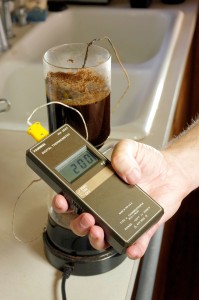 I realize this article will be read mostly by coffee enthusiasts already so involved in brewing that they likely have their own views regarding brewing, and its three most important variables: time, temperature and grind particle size. But, lately there’s been dissention over what for many years appeared to be consensus among the trade. As brewing as an art and craft (hence my book’s title) has developed, there are those who question the basics.
Questioning the basics is, I think, a good thing. Anyone who’s been in family counseling knows it’s a healthy thing to revisit how you divide labor. When it comes to processes, it’s a good thing to reconsider the variables. My observation is that coffee brewing is still being analyzed. Don’t forget that as roasts, types of beans, brewing methods and consumer tastes change, it’s a good idea to do a few experiments. If they confirm the basic parameters, so be it. But, they may not, and why keep doing something wrong?
Historically, much coffee was boiled. I can think of all kinds of reasons for this: pre-chlorination food safety, ease – the bubbles tell you the water’s ready, and thrift – the cheapest way to maximize extraction strength is to use the highest temperature.
The Coffee Development Group, or was it the Pan-American Coffee Council – some predecessor to the Specialty Coffee Association of America (SCAA), did extensive testing, using food experts, not just coffee folks, which resulted in the standards that have been in place for many years.
They include:
• Grind size specifications, basically finer for short extraction times, coarser for longer ones. The current challenge with enthusiasts likely to grind at home, is how to confirm this. It used to be written right on a coffee can.
• Brewing Temperature – It’s easy to tell consumers: “Under Boiling”. Everyone seems to get that now. The last percolator I came in contact was in my late Aunt’s estate sale. BTW, 195°-205°F just tightened to 196°-205°. The extra degree may or may not matter to you, but according to my little birds, the US and European specialty coffee groups wanted to share the same standards for a variety of reasons.
• Contact time – In my observation, this is the one most difficult to control, partly because it’s so difficult to measure, especially in intermittent drip methods. Ever tried?
Recently, I’ve run into a number of enthusiasts, baristas, brewer designers, who complain like music composition students do about tonal scales. Recently, I was sitting in the office of one of the most influential big-coffee business owners, who many would say personifies the word establishment and he told me he believes 200°F is too high a brewing temperature. I’m sympathetic. After all, what kind of thinker would I be if I didn’t like to challenge rules? “Question Authority” – That’s my bumper sticker!
But, I’m here to re-commit CoffeeCompanion to following the rules, at least for now. We need some kind of reference point, or a dialogue is useless. The fact is that a great number of culinary experts were consulted in creating the standards. These folks had taste buds. This wasn’t a casual industry lock down for convenience.
I will always challenge the established rules. I will also follow the standards and use them for my tests. I may expand my tests in certain instances but I will always strive to identify those instances.
Meanwhile, I urge those of you who are doing your own home experiments, playing with brewing parameters to customize your methods to your individual tastes, a worthy pursuit even within the parameters, to start off following the standards. If you decide your Chemex or Aeropress tastes milder, better straight (minus cream or sweetener) when brewed at 180°F, no one is going to take the children from your home.
But, as my music theory teacher said to us in college, “Learn the rules so they can be broken by design, not ignorance.”
We are living in a golden age of brewing. There are all kinds of new brewers, the re-discovery of old ones. The profession of barista confirms that the industry gets that how its coffee is created in a coffee establishment makes a difference. Remember: Wine tastings don’t need bartenders, but coffee tastings need baristas.
CoffeeCon, my ‘lil ol’ coffee show is great fun, but I have an agenda as plain as Karl Marx at a school board meeting. I want consumers to discover coffee as a culinary art and invest the same passion they do into cooking into brewing their coffee. Anyone can do a coffee tasting. We are a coffee university.
So, just FYI, I will keep taking any coffeemaker’s temperature, use a stopwatch to check how long it subjects your (ever-increasing-in-cost) ground coffee to hot water, and play with grind and include those results in my reports.

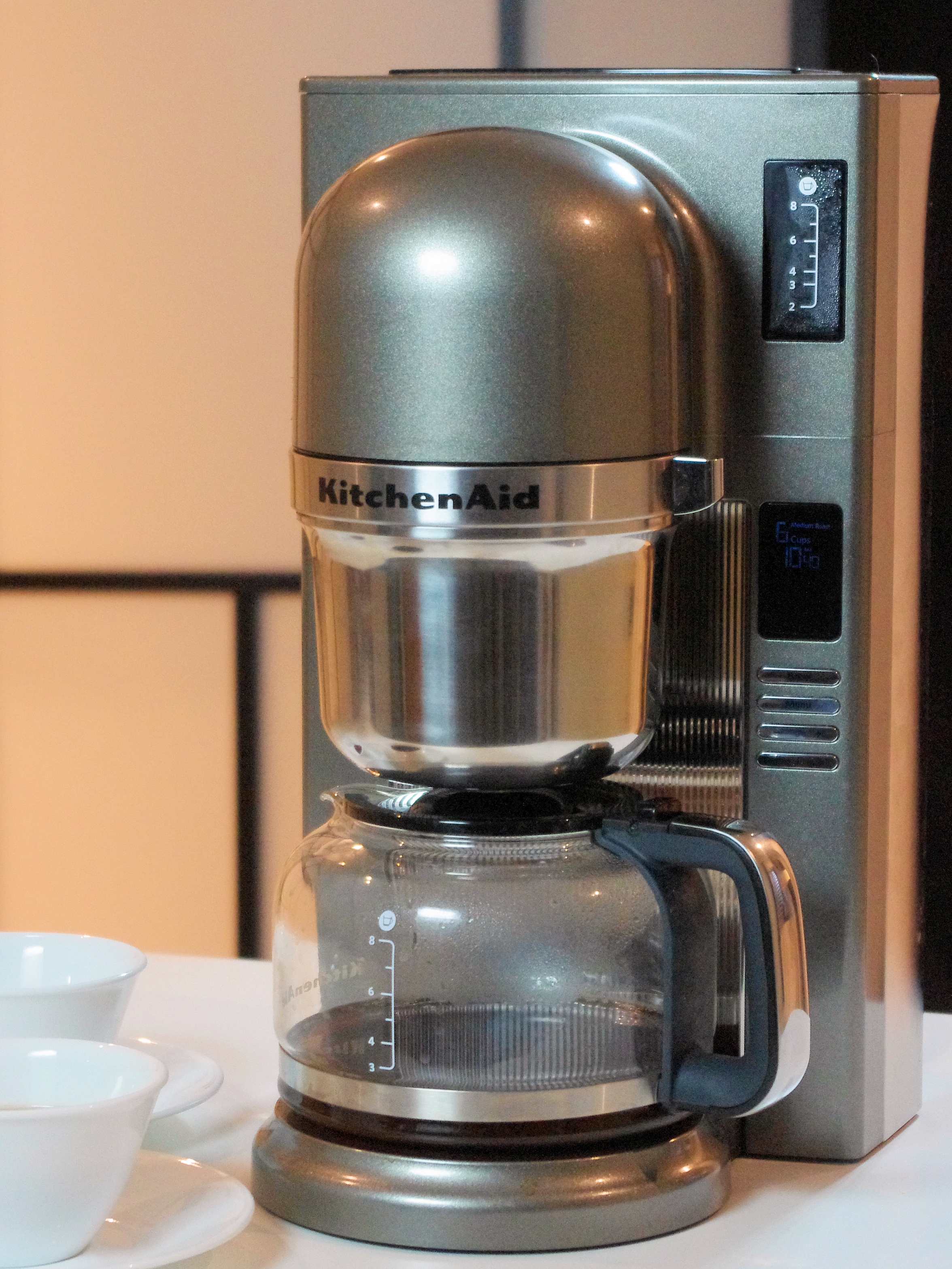 KitchenAid’s new 8-cup automatic drip Coffeemaker is proof that appliance manufacturers now take coffee making parameters as seriously as they do any culinary art. KitchenAid has long been a coffee innovator, with high build quality and within reasonable price points. This new model has literally been years in the making.