By now, everyone has likely seen the Conan coffee clip where his coffee snob employee snubs an Intelligentsia espresso. Don’t worry. Intelligentsia is laughing all the way to the bank, as the snub gave them an opportunity to put the dissenter in his place. Meanwhile, it warmed my heart to see coffee given its minute of fame (actually eight minutes of good air time). There were some genuinely funny moments in it.
Conan O’Brien is among my favorite on-air comics. He plays his everyman role well. Jordan Schlansky, plays the dour office coffee snob to perfection. An unfortunate side effect of becoming a connoisseur in any art appears to be the loss of humor, and he characterizes it nicely. This is all good. But, what, if anything did the segment accomplish in teaching a mass audience about coffee?
Single origin versus blends – Jordan points out that he prefers a traditional Italian espresso over the single origin American one prepared on camera by an Intelligentsia barista. Most Americans probably know that Starbucks did its own version of espresso, but likely some learned for the first time that the latest round using one coffee type is still very different from the original drink. Jordan made a point that traditional espresso almost inherently contains both Arabica and Robusta coffee types, a blend which he thinks tastes better.
Roasts – After warming up by questioning the use of a single origin over a blend for espresso, Jordan challenges the holy grail of the Third Wave – its roast. He taunts Sam and Eden, the two Intelligentsia employees by attacking their light roast’s suitability for espresso. Sam points out that they chose espresso since Jordan stated it was his interest. One of the things I like most about Third Wave is its return to brewed coffee to strut its stuff. I wished they’d brewed using a Chemex or Hario, myself. But, it’s a fun and still informative bit.
Brewing – Jordan finally takes issue with what he identifies as over-filling the coffee machine with grounds, creating a too-strong coffee, versus his nostalgia for a more pleasant (if weaker) 7 grams per 25 ml water (traditional espresso shot). He is here, in effect, really attacking the Americanization aspect of Third Wave espresso. Here, the Intelligentsia on-air staff, who do an overall admirable job keeping straight faces in what must have been a high-tension situation (all of professional coffeedom’s eyes were no doubt on them) had one of their lesser moments, in my opinion. Admittedly it’s a tough theological coffee question (I’m not sure who could have really answered it better) but when basically asked if their coffee is too strong, barista Eden answered that they have determined the strength using scientific measurements. Her words: “What we are looking for is the proper amount of extraction for each coffee particle”. Jordan retorts, “By whose criteria?” I know this is supposed to be fun, but in my opinion, this is a key question, one I hope resonates with the industry’s leaders, who should really be careful before they use numbers as arguments. In other words, it all really still starts, not with science, but with someone’s opinion. While I believe this is really how it should be (and in reality, must be), it should serve as a deterrent to the idea that somehow anyone has a definitive lock when it comes to these numbers. Meanwhile, to get consumers to even think about measuring a recipe is definitely good.
Third Wave identified – Just as in the 1960s most kids nationwide learned the Southern California surfing jargon in the Beach Boys song Surfin’ USA, there may be a million TV viewers who learned the term Third Wave for the first time in this segment, as well as got at least a partial definition of what it means. I refer of course to the description of coffee growth in the US (and elsewhere) as split into waves. First Wave (as I understand it) refers to the general explosion of a culinary coffee market after it was discovered that beans given extra farming and grading attention were special and the term Specialty Coffee (credited to San Francisco coffee importer Erna Knutsen) was coined. Second Wave is often given to Starbucks, Peet’s and other roasters’ emphasis on (darker) roasts that called attention to the roaster, with an emphasis on espresso extraction. Third Wave became a popular term (I heard it first from legendary coffee pioneer roaster George Howell) to describe single-origin coffee roasted (usually very lightly) to emphasize its origin characteristics at the expense of roast development and (in the extreme) any hint of caramel flavor. The best part of Third Wave coffee (to me) has been the emphasis on brewing, often using manual devices, and a return to filtered coffee over espresso as the preferred extraction method.
Identifying and introducing to mainstream conversation the term Third Wave might be the anthropologist’s desert. I know it made my heart skip! Having consumers learn what the heck some of this means, arguments and who’s right aside, is good for business. It does more to give people an understanding why they’re lining up and waiting ten minutes to get their morning coffee at Intelligentsia (and others) each day. Yes, there will be some who will have an epiphany that they really don’t like what they’re getting and may switch back to something plainer. But, there will also be water cooler coffee talk at work. Some will try the coffee minus cream and sweetener (Intelligentsia does offer it, as do most Third Wave coffee environs). Some will become super elitist and seek out the traditional espressos (ie: Bay Area’s Mr. Espresso) and decide for themselves. The important thing is they will have their coffee consciousness raised. And, yes, they may start questioning the standards, realizing that their own taste buds are entitled to be heard in the quest for the perfect cup.
If this was supposed to be a debate, I think everyone won, with Jordan winning some surprising points, no doubt in part because as a performer he was less nervous, but also because he was able to slip in some genuine questions many of us are asking, and I am overall a fan of Third Wave Coffee. Intelligentsia’s Sam Sabori and Eden-Marie Abramowicz handled their parts with aplomb and they were good at advancing their company’s image without themselves seeing too snobbish. It’s hard to be on the spot and they were really playing themselves, not roles, a far more self-conscious circumstance. The heat was on, and the TV people are always going to win, as Bill O’Reilly, Jon Stewart, Ellen DeGeneres prove each airing. Conan O’Brien himself, really played the straight man, giving his fellow player the main character role. Points were made, I think in the consumer’s behalf.
A glance at social media since shows the industry saying how important it is to get the word out there. I hope behind closed doors they are also saying they need to listen to consumers, mainstream and also informed ones as the segment’s Jordan Schlansky, who I continuously find are raising questions about coffee. I keep saying the industry needs a healthy combination of leading and following consumer tastes. Most industry professionals would I think agree with this. There really are some high-end consumers out here who are as knowledgeable as the trade professionals.
Kudos to all who created the segment, and especially to the Conan O’Brien Show. They really gave coffee a boost in this entertaining segment.
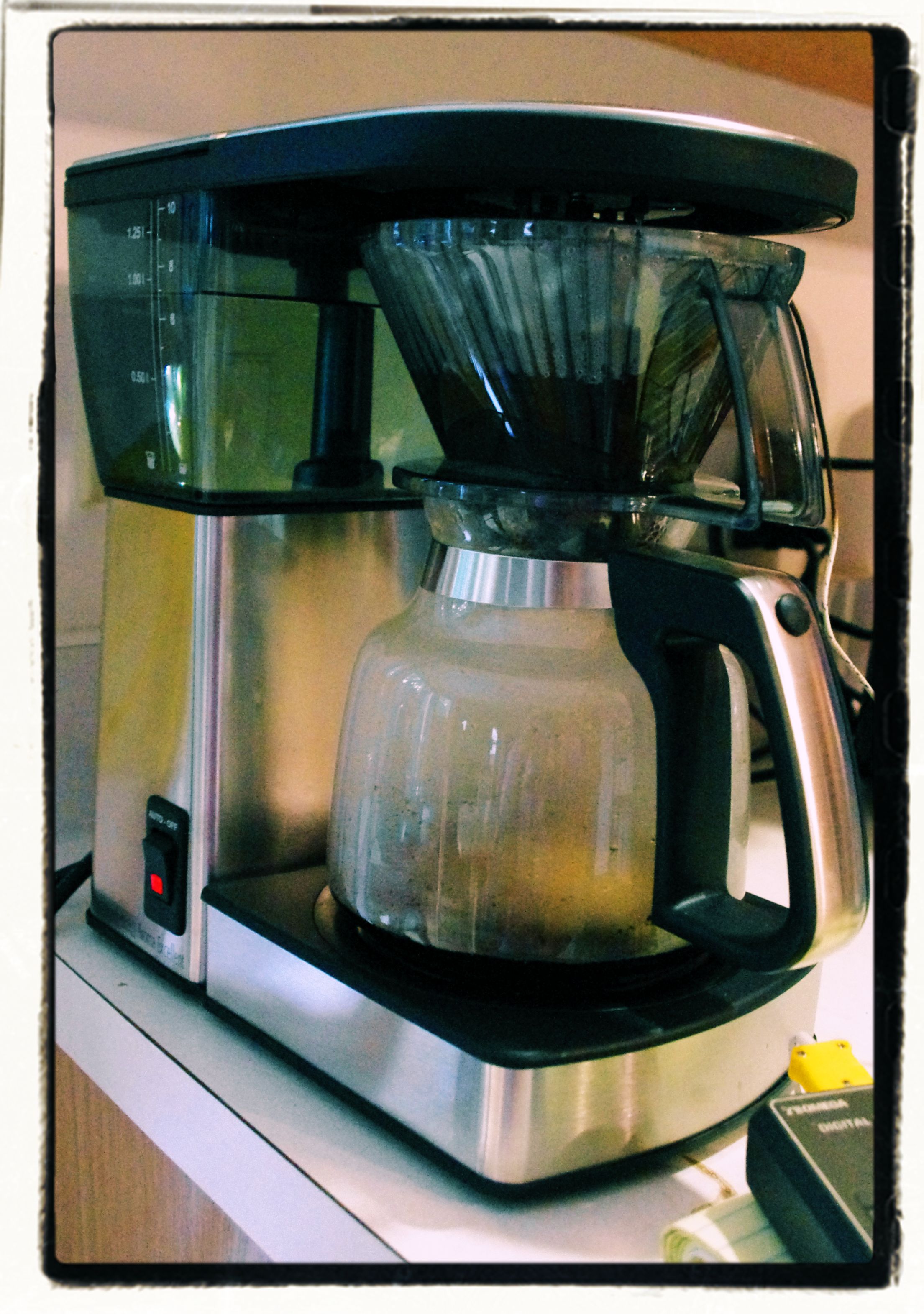
Automatic drip coffeemakers used to be considered a dead category. No longer, there are several new machines. The Brazen is well named because it’s the most daring and innovative. It is the brainchild of inventor/entrepreneur Joe Behmor, whose Behmor drum roaster is popular among home roast enthusiasts.
Joe is my kind of guy. I like options and he gives us lots of them. This is the first home consumer model that has the following combination of features:
• Variable temperatures – you can customize the Behmor Brazen each time you brew for any temperature between 180°F and boiling. This is the only consumer automatic drip machine I know that offers this feature. Coffees taste different when the brewing temperature changes.
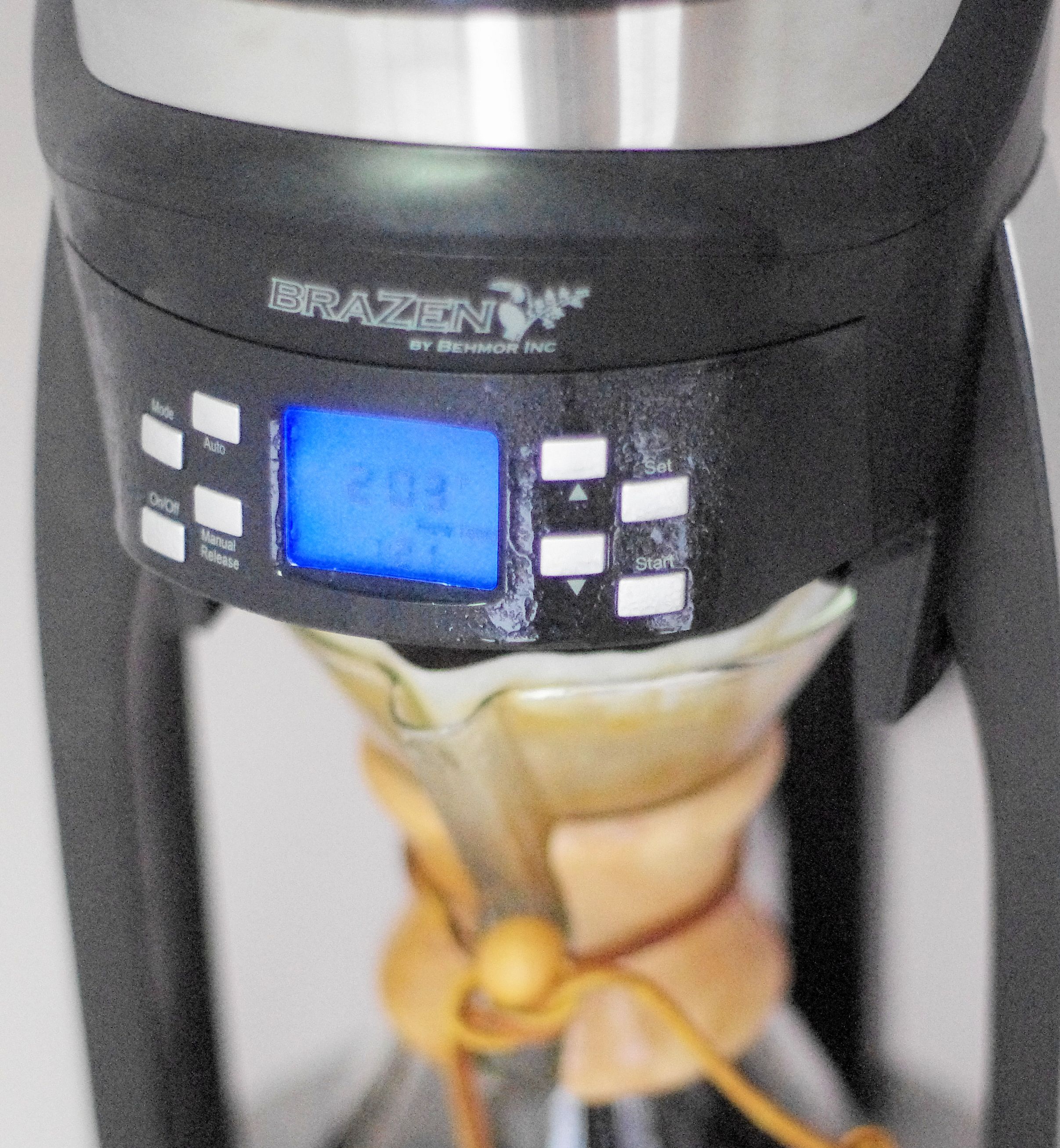
• The Brazen features on-board temperature readout that constantly monitors the temperature it’s putting out. Most manufacturers wouldn’t dare.
• The Brazen has a pre-infusion cycle. This means your ultra fresh grounds can get wet with a few ounces of how water, then they can rise and fall, so the rest of the brew cycle can proceed normally. It’s a huge taste difference in the cup and other than manual drip users almost no one offers this feature. Joe’s automated this. You can choose any time between one and four minutes depending upon the coffee grounds’ freshness and your patience.
• The Brazen even supports and encourages unorthodox practices like inserting a 5-cup hand-blown Chemex in order to automate a manual drip maker. The unusually wide dispersion sprayhead gives you kind of water coverage needed for a number of manual drip brewers. Can you imagine any large manufacturer taking such a magnanimous, inclusive approach?
There are other features, but these are the ones that excited me and that distinguish the Behmor from its competition. Suffice it to say, this is an aficionado’s brewer. Of course, promises must be kept by test results. It’s all for naught if it doesn’t deliver.
It also could mean a consumer’s worst nightmare if complicated menus and settings limits the Brazen to the coffee elite. How easy is it to program?
Let’s answer the second question and then go to test results. The menu is intuitive enough to be a 90s-era Sony camcorder. Pat and I needed to leave on a weekend drip in the middle of testing. I left the Brazen set up in my kitchen, expecting it might frustrate my wife’s cousin Leigh who stayed over and is fond of calling electronic settings “thingies”. Happily she was able to brew beautiful coffee with a 30 second tutorial as I was walking out the door. You literally could buy one of these and use it without every worrying about any of the settings, or put it off until you get picky.
As far as test results, I have good news. The temperature is accurate and rock steady. The sprayhead can be observed and it gives ample coverage. Thanks to this and the pre-infusion feature, grounds end up good and soaked as it should be. The amazing thing was being able to report this using coffee hours fresh from being roasted.
Fresh roasted coffee foams up when water hits it. Anyone who brews using a kettle knows to simply wait until the grounds rise, the carbon dioxide gas emits and the grounds all back down again. The Brazen Behmor accommodates this by spraying just enough water to wet the grounds. Then it stops brewing, which can be programmed to last between 1 and 3 minutes, depending upon the freshness and how determined you are to address it. After that it brews continuously. This is an effective way to accommodate fresh coffee. The only other coffee brewers in history I know of that similarly dealt with fresh grounds were the Chemex automatic, many years gone and a Braun brewing in the 1990s which used what they termed interval brewing.
The coffee I did most of my testing with was a Costa Rica from Arnold’s Coffee in Elizabethtown, Kentucky. Arnold roasts beautifully, one of the best. However, I have a confession. I don’t usually care for Costa Rican Coffee, even Bill McAlpin’s, perhaps the most OCD coffee producer in the world. I swear he dusts the coffee trees. Anyway, using 63-65 grams of coffee and brewing temperatures upwards of 206°F, I finally found the caffeinated Nivarna I found I could emulate a French press taste using lower temperatures. I’m sure people are going to start posting their favorites here and elsewhere. This brewer puts control and fun in your hands. I have no knocks or gripes whatsoever.
Perhaps my favorite tests were using Oren’s Daily Roast’s two Guatemala coffee varieties, one from Antigua and the other a Coban. With the Brazen I had a great time brewing each to perfection. I found I was able to optimize each coffee to my taste buds at brewing temperatures in excess of 200°F, the Coban tasted ideal brewed at 203°F. Short of brewing in a vacuum maker, I don’t think I could reproduce the flavors I achieved in any other brewer.
I repeated the above tests using a five-cup hand-blown Chemex (the six-cup more commonly available is just a bit too big to fit) inserted into the Brazen’s carcass. It performed beautifully. Joe Behm brilliantly devised a manual release setting that allows you to choose a brew temperature, get the water up to that point and release showers of hot water over your Chemex. The results matched or exceeded what I got using the Behmor by itself. Perhaps I’m biased in favor of the Chemex filter or the multiple pauses during brewing. At this exalted performance level one should expect a little subjective hair splitting. Suffice it to say it’s another brewing option that will increase the Behmor’s value to its audience.
Dynamic Duo: Brazen with Chemex Insert
The Behmor Brazen takes paper filters, but after a few times, I just started using the supplied metal filter and it works just fine. Joe Behm told me he prefers the gold filter. My only caution is to be sure to keep it clean, immediately scrubbing it after use with a little perfume free detergent.
I prefer glass carafes, but the thermal carafe works fine, does a good job of holding the coffee temperature steady for an hour or more. I just make sure I thoroughly clean it when we’re done with the same detergent regimen I use for the filter. But, I just hate cleanup.
Build is good. Obviously I can’t judge long-term longevity. I try to avoid the disdainful and vulgar subjects of money and value, but I was actually surprised to find this much technology in the $200 price range. Consider other passions where cutting edge technology can be had for so little.
Joe, thank you for this brewer. It not only holds its own amidst the other top performing automatic drip machines, but French presses, Hario v60s and Chemexes as well. For the coffee brewing hobbyist, there is really nothing else out there like it.
When you pick up a bag of Kona blend coffee how much Kona coffee do you think is inside? I would guess most folks would guess around 80%. How about 50%? 10%? It may interest you to know at Safeway for years it has been an honest 5%. I say “honest” because apparently there is no real coffee blend percentage regulation.
Kona coffee farmers complained. They feel that the product bearing their origin name on it should be labeled with a percentage breakdown. Last year, Safeway voluntarily agreed to a Hawaiian Department of Agriculture request and pledged to increase the Kona percentage in their Kona Blend to 10% and reflect it on the package. Kona farmers weren’t thrilled with the change, but at least it was in the right direction. Their latest complaint is that nothing appears to have changed at Safeway. The farmers claim Safeway is not keeping their word and that consumers are still buying coffee that’s only 5% Kona and 95% commodity blender quality coffee in the old unmarked bags.
Safeway’s answer? Safeway vice president of public affairs Brian Dowling says, “Given the product shelf life, packaging used before the (changes) may still exist on store shelves or elsewhere in our distribution chain,” then added that that the company doesn’t plan to destroy or dispose of those products. I am surprised to hear anyone at a food supplier say their company doesn’t plan to destroy or dispose of old perishable products. I guess my followup question to Mr Dowling would be, “Ever?” So, the 5% Kona blend is still on their shelves because it’s still well within the freshness range they accord the product. To me their defense is more alarming than the original charge. They agreed last year. Does this means that all these bags on the shelves were packed and labeled before 2012? That seems like a long time, even by a supermarket’s standards.
What kind of coffee flavor can there be in a product this old? Just to give reference, coffee is best consumed within 2 weeks of being roasted. Assuming it is packaged in an oxygen-free environment in proper packaging, some large-scale roasters in the industry claim it can preserve its flavors for up to six months, although there’s dissention even within their ranks. I would argue after twenty years of personal tasting that coffee is good for me for about a month after roasting, regardless of packaging. Only freezing significantly slows the staling of coffee beans and this is still controversial.
So Safeway is saying, relax we’ve still got plenty of coffee so old it predates our year-old pledge right there on our shelves. Nice.
None of this is about safety, so I’m not pushing new laws. This is about taste, a company’s in-house freshness standards and their word. I don’t blame the farmers for asking for more, but I’m going to offer a quick guide to getting your money’s worth when you shop for coffee.
During the extreme heat of summer I took the time to gather some video highlights of CoffeeCON 2012. I’m already thinking about Coffee 2013 with more classes, more speakers, more roasters, more free prizes and more music. I want to triple the size of the February 25th event and offer it to you, the coffee loving consumer for free, just like before. I have a long and hard road ahead to convince the coffee industry to financially support CoffeeCON, the world first coffee university and conference just for consumers, once again.
The bottom line is that big and small business alike want to know if you’re interested??? If I can get enough views, likes and comments I’ll be able to get the funding the event needs. I’m are looking for 10,000 people to view this video and like it. Let me know if you were there in the comments area. All of this will help the coffee industry understand you want this event again. Please watch and vote today.
Bodum has always been known to produce the very best in manual drip methods especially the French Press. This year they’ve decide to take everything they’ve learned about manual drip brewing to create their own version of the automatic drip coffeemaker. While I haven’t tested this new coffeemaker yet I got a first hand demonstration at the 2012 International Housewares Show in Chicago. I can already tell you that I like the idea of the see through design that shows off the quality electronics inside.
So take a look at the video presentation I created until I can review this new coffeemaker in my own kitchen.
In what seems to me a blink of an eye, I went from the nonstop energy of CoffeeCON 2012, my event for coffee consumers everywhere, to the 2012 International Housewares Show, the world market for new coffee appliances. In the coming weeks and months I’ll be sharing video’s, pictures and thoughts on CoffeeCON but first you’ll want to see and hear what manufacturers are doing to brew the world’s best beverage. After years of coffeemakers playing second fiddle to beans, coffeemakers are getting more attention and Housewares is my number one trade event to find the new and improved. I’ll be focusing on different manufacturers’ latest and greatest during the coming weeks at this blog.
My first video report from Housewares 2012 comes from Krups. This manufacture outdid themselves this year by bringing out an impressive array of coffee machines. The first one I looked at was Krups on Request. Bucking the trend for single serve coffeemakers this machine allows you to brew as little or as much coffee as you would like, up to 12 cups.
What’s different about this machine is that it automatically pours the coffee through a spout, a bit like a water dispenser, rather than into a coffee carafe. It has an internal removable steel carafe with a special heating system to keep coffee hot.
Next I looked at the Krups KT600 Silver Art Coffee Machine. Beautiful to look, what I call coffee jewelry. I don’t know how it brews yet but it will certainly draw guests attention in your kitchen.
Of course being Krups there was an extensive line of grinders of all types. I was impressed that most of them were conical burr grinders.
Speaking of conical burr grinders there is one built into the KRUPS Barista EA9000 One-Touch Cappuccino Machine. This fully automatic machine was one of 60 finalists in the first annual IHA Innovations Awards. It seems to have everything a machine of this quality should have for making the perfect Cappuccino.
Take a look at the video report posted below. While the machines make a statement and I enjoyed my conversations with the great people at Krups, until I test them I can’t give you a review of any of these products. I can however at least give you an introduction. There are lots of machines so let me know which ones you want to know more about so I can plan my in-depth review calendar.
During the coming weeks you will see more from different manufacturers from the International Housewares Show 2012.
CoffeeCon is a lifelong dream to give consumers a chance to see and compare different coffees and coffeemaking gear. When I first started my interest in coffee, there were few coffeemakers. Now there are many. The internet’s role in this is obvious. It’s now easy to see and read about so many methods and bean varieties. But, the internet has one limitation: It is not possible to come face to face with these methods. Like shoes, loudspeakers or other products, the missing element is undeniable and huge. I’ve ordered so many coffees and coffee brewers, only to find they did not suit me. Sometimes just a taste will tell. Other times I’ve held off, only to find by chance that a given method was perfect for me.
Well, CoffeeCon answers this need. You simply come and compare. Have you wanted to see what the Chemex fuss is all about? Wondered if the vacuum method is too complex? Will the French press give you too many leftover grounds in your cup? Now you’ll know.
There’s a second reason for CoffeeCon. I’ve met a few experts during my quest, who know things, some big, some little, about how to brew with various methods. Coffee can easily produce as complex a beverage as wine, but wine comes to us as a finished product. Chill, open and drink. Coffee does not. Coffee requires some knowledge. It is really a cooking art. Not everyone wants to become a renown coffee chef, but to be able to brew a perfect cup is not really beyond the scope of anyone, but, like riding a bicycle, baking cookies or any other worthy creation, we need to be shown once by someone who knows how to do it. I say this as a published author of two books on the subject, a producer who created a how-to coffee video and writer of countless articles on the subject. None of it is as effective as seeing it performed by an expert, and then doing it yourself with some help. Again, the web cannot really do this. CoffeeCon can.
If you stop reading and sign up for CoffeeCon here, that’s fine. But, there are a couple more reasons I think CoffeeCon’s time has come.
Consumers are a powerful force in any industry. They are not organized and never meet. We are isolated and that prevents us from having the clout we need. I think people in the coffee business will benefit from meeting us. They need to hear our concerns. They try to buy focus groups and mimic other industries, but there’s not substitute for them hearing from us just what we think. A year ago, some people in the coffee business got together to discuss some important world coffee ecology issues. The attendance was several coffee roasters, a coffee importer, a brewing manufacturer and a trade organization administrator. Like Christ at the United Nations, not a single coffee farmer was invited, nor were any consumers. CoffeeCon changes this.
The final reason is so simple I’m surprised no one has considered it before. Coffee aficionados have something in common. I’ve attended wine tastings and one of the fun aspects is meeting other red wine enthusiasts and hearing their opinions, not just about wine, but where they come from, what their best experience so far was, that kind of thing. Again, the web does not really bring us together, well it does, but only so close.
Come be a part of CoffeeCon 2012. If nothing else, I want to meet you. I want to share a cup or two. I want to show off my favorite brewing method. What is it? Come and find out.
For a long time the Technivorm coffee brewer has been the out-front champion consumer auto drip machine. Other than Bunn, there’s been no one that’s even been close. At last year’s Specialty Coffee Association bash in Houston, I spied a truly interesting Technivorm lookalike. I begged a sample and one day my UPS driver showed up with it on my front porch.The Bonavita 8-cup looks a lot like a Technivorm, enough to be called a knock-off. But, knock-offs serve an important place in consumer culture. They give those of us down the working class a chance to taste the gear caviar we otherwise can’t afford. So, how does it measure up?
First, the Bonavita hits the basic temperature of the Technivorm, not quite its ruler flat 200°F, but comfortably in the 195 to 205 industry spec. This will be made a big deal of by some, and I can’t deny it is at least partially true. If you’re a total perfectionist, the Technivorm will still be your machine when it comes to the art of delivering stable 200°F water to your grounds. The Technivorm produces a magical full 40 ounces in just over six minutes. This upstart brewer is capable of making the same size batch in just over five. Whether this is an improvement or not is subjective. Some might say it’s closer to the ideal “American” cup. All in all, it’s a pretty impressive feat and testament to the Bonavita’s beefy heating element. In the video review I referred to ramping up my grounds from 60 grams to 64 grams drip grind coffee for a full Bonavita pot. I have since found that simply grinding a notch finer and 60 grams does the trick.
There is one area in which the Bonavita 8-cup outperforms the Technivorm and that’s the ability to get all the grounds thoroughly soaked during brewing. This has always been the Dutch coffeemaker’s sole weakness and the Bonavita just does it beautifully, and it is a very important attribute since it means you get full, even extraction for all the precious coffee grounds. This is an area that many will miss as there’s no real easy industry specification. It’s not easy to measure, although it is simple to observe. The Bonavita does as good a job of any automatic drip coffeemaker tested so far, equal to the famed Kitchen Aid 4-cup and recent Kaloric models. And, in my opinion, this is one of the most important areas of accomplishment for any automatic coffeemaker.
The one area where the Technivorm might prove more cost effective in the long run is longevity. Technivorms are the coffeemaker equivalent of Volvo automobiles. My 30 year-old Moccamaster just chugs away. But, none of my tests indicated anything inherently slapdash about the new Bonavita either, so time will tell.
The Technivorm has a two position setting that really works when making a half batch. If you regularly make less than a full pot, it’s a nice and useful economy feature and it’s missing on the new competitor’s. I did not even test the Bonavita in any but full batch modes. Assume you will make a full pot each time in order to get the performance I did in my tests.
I’ve been brewing with the Bonavita daily for nearly three months. I brewed Counter Culture’s Finca Mauritania El Salvador with it, as well as their Jagong Sumatra, one of my current favorites. All superb, as was Oren’s Daily Roast’s Cup-of-Excellence Nicaragua La Ampliacion. I found it was almost boring in its ability to brew brilliant coffee batch after batch, minus any futzing.
I tested the glass carafe, my preference, but there’s a themos version on the way. It’s worth noting that Bonavita has earned a Specialty Coffee Association of America certification. I prefer glass carafes as they are easy to wash and really get clean, plus I toss any coffee after 30 minutes regardless of how it’s stored. In my opinion thermoses offer very little advantage.
I’d say this machine is going to give Technivorm a run for its money and a lot of people are going to go for the extra cost savings and drink some pretty excellent coffee at a bargain price. Considering there are millions of coffee drinkers, there’s room for more than one machine that performs to spec. If you’re looking for a top auto drip brewer, the Bonavita definitely fits the bill. It gets a top rating from the Coffee Companion.
Ah, the perfect cup of coffee. Once we’ve had it, we spend our lives trying to find it again. There are so many brewers and brewing methods, grinders, not to mention all the beans from around the world. I’m Kevin Sinnott and I’ve spent my life as a passionate prosumer. I’ve never gone to the dark side and started my own coffee company. Why? Because I’ve had the opportunity to get to know just about everyone in the business. I’ve never had the desire to become one of their competitors and because of this I have the industry’s trust. The top coffee players talk to me and continue to share their extensive knowledge base for which I’m grateful.
I want to share everything I’ve learned about the bean and brewing with you the passionate coffee drinker. At CoffeeCon you will get to meet the industry leaders, top coffee bloggers, learn the best brewing techniques, becoming an expert in all brewing methods. In fact after attending the classes you will get a Coffee Companion Certification recognizing you as a Certified Coffeeologist.
You will sample coffee from a wide variety cafes and roasters. You will be introduced to new interesting coffeemakers and some not yet been released. Want to know what Fair-Trade or organic labels mean? You’ll know after attending this event. It will transform you! During the coming weeks watch this space as we grow CoffeeCon into the coffee event of the year.
I want to hear from you in designing this event. You and I are the consumers and drivers of this industry. This will be a two-way dialog as coffee drinkers are the ultimate experiencers of the beverage. The coffee industry is waited to hear from us. The event is being held at the ultramodern IBEW building right off the Reagan/88 Tollway in Warrenville, IL.
Space is limited and this event will fill-up quickly so register to attend now.
Watch this space in the coming weeks as new information, videos and details emerge.
Andy Griffith Show without Sheriff Andy Taylor making a trip to Aunt Bea’s lace-curtained kitchen and pouring himself a cup of Maxwell House from the percolator.
My father had a somewhat different reaction to the trouble that boys make than television’s Leave It to Beaver father Ward Cleaver. Ward should be brought back, if just to prove it is possible to have a cup of coffee to face every life challenge and still maintain calm. Although every episode I remember featured the electric percolator, there is a persistent rumor among coffee aficionados that there are early episodes showing a vintage vacuum coffee maker in June Cleaver’s pristine kitchen.
Perry Mason - Lawyer - Coffee Drinker
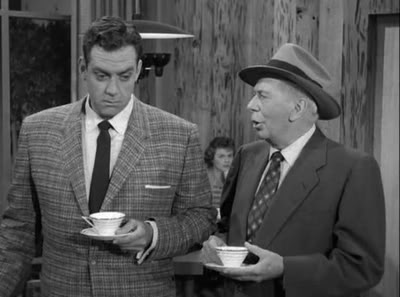
Those impressed with the legal might of the recent “dream team”, must have forgotten Perry Mason. Raymond Burr, television’s he-man lawyer who would have scoffed at the “power tie”, took just fifty-four minutes each week to have his client found innocent rather than the sheepish “not-guilty.” Mason, fueled on coffee throughout the seemingly twenty-four hour days he worked, plowed through and did the police and prosecution’s work as well, never ending a case until he produced the real murderer. No wonder the LA police have never recovered from his cancellation. Della Street, in Barbara Hale’s superb and understated performance, insisted on bringing fresh coffee into every scene. I viewed one episode where Mason brought a half-dressed suspected damsel to Miss Street’s apartment in order to hide the accused from Lieutenant Tragg. 3 a.m. or not, Mason’s secretary instinctively went to the kitchen and brought forth freshly brewed coffee.
James Bond may have been the movies’ first spy, but for most American kids, it took two spies, Napolean Solo and Ilya Kuriakan in The Man From U.N.C.L.E. to really cement our relationship to these dogs of the Cold War. U.N.C.L.E. headquarters was stocked with both young studs whose muscles were held in check by firearms in shoulder holsters and beautiful false-eyelashed women carrying coffee carafes. Napolean and Ilya didn’t bother to wait to arrive at headquarters to drink coffee. A favorite coffee moment occurs right at the start of “The Deadly Decoy Affair.” David McCallum, as Ilya, darts out of his New York jazz lp-filled apartment brandishing a coffee cup and, still sipping, slips neatly into Robert Vaughan’s (Solo) convertible. Moments later they drive up inside the U.N.C.L.E. garage, where they do gun battle with some enemy THRUSH agents. Although the coffee cup disappears in order for Napolean to shoot two or three of the jack booted thugs, his coffee-charged bravado carries him proudly when, surveying the mass of bodies he and his comrade have just eliminated, he deadpans, “We haven’t even punched in yet.”
My parents always tried to stop my watching Dobie Gillis. I don’t know why this particular program ranked so low in their book. I remember my mother voicing concerns that young people might “get the wrong” idea watching Maynard G. Krebs, Bob Denver’s beatnik character. Naturally, we watched every episode, although the only striking memory I have is of seeing cans of coffee in father Herbert T. Gillis’s corner grocery stacked behind a sign advertising 99 cents per pound prices. I always longed for a scene where Maynard would introduce us to his beatnik friends at a coffee shack, but somehow the show’s producers failed to utilize Maynard as anything but a way-out loner, with no other links to the subculture but his dress and scruff-beard. At the other end of the unreality spectrum, there was Hazel, an already out-of-date character developed in the post World War II GI promise/fantasy of upper-middle class luxury for having beaten both Germany and Japan. My parents both watched this program, laughing buckets when Shirley Booth ran her buxom frame at trot-speed in response to any irrational requests from her scatterbrained family employers. Hazel‘s ultimate obnoxiousness was that she appeared not to pay any attention to how many scoops of canned coffee she spooned into the by-then standard electric percolator. Here’s hoping the coffee was better served at the inevitable family therapy sessions where this dysfunctional broadcast clan must have gone, maid and all.
Coffee was best left to the working class, after all, television’s real audience backbone. While Hazel’s boss hardly touched his coffee, Dragnet’s Joe Friday took his coffee like communion, especially in the series’ 1950’s heyday. First with partner Ben Romero (shot and killed in the series after actor Barton Yarborough died of a heart attack) and then with Frank Smith, Friday lived on coffee and cigarettes, a diet no longer fashionable. Unlike modern police methods, Friday’s always produced the right suspect, with airtight evidence and likely a fully signed confession, although the use of a high intensity lamp aimed directly at the suspect’s beady eyes seemed to help.
Jack Webb‘s staccato production style seldom allowed for close-up shots of coffee making, but when he and a sidekick poured themselves a steaming cup in their squad car during a stakeout, you knew it was good and strong. No matter how many cups, Friday never had the coffee jitters. If he did, he knew he could release them by taking an extra long puff on a filterless Chesterfield cigarette, or by delivering one of his famous clipped lines of sarcasm to a reluctant witness, always to the nods of everyone present. I like to picture Webb, night creature, sitting in a late-night coffee bar, sipping hot java (even his first name was slang for coffee) in his trench coat. That dream, by the way, is still in vivid black and white. Later Webb shows, filmed in weak color, fail to provide any of the atmosphere of the early series. It may be my imagination, but I don’t think there’s much coffee, either.
A lot of people have fond memories of Bonanza, but not I. I remember it being on Sunday night, which was right before Monday’s school week began. Wrestling with bouts of depression looking towards another week of academic imprisonment, I felt little affection for this all-male ranching family. Their coffee came from stovetop pots, indicating that they were boiling the brew. There is no romance in any aspect of old west coffee making.
I couldn’t really pretend to discuss television’s treatment of coffee without mentioning that 60’s angel of bad coffee-making and domestic meddler, Folger’sMrs. Olson, played by some bad actress whose name escapes me. The script was the same for all these ads: A 60’s housewife, distraught at having her lack of social and culinary skills exposed before her husband’s boss/mother/golf buddy is about to fall apart (too many diet pills?) behind the kitchen door, when in comes this smiling patron saint of middle brow entertaining, Mrs. Olson. The young woman moans that she’s never made good coffee (the most believable piece of dialogue contained) and now is compelled to perform. Does Mrs. Olson glare over at the electric percolator and accompanying can of supermarket swill and growl, “There’s your problem, Bimbo!”? Of course not.
In true corporate form, Mrs. Olson, trademarked “Svedish” accent in high gear, assures her tenderly that there’s no secret to making good coffee. Then she ushers her young charge back into the living room and proceeds, I believe, to pull a small sack of beans out of her purse and probable hand grind them and then brew them using a vacuum coffee maker. All the audience knows is a few frames later, in walks Mrs. Olson with a percolator (no doubt as a serving vessel) full of fresh-made coffee. Hubby, realizing it’s the weekend and bubbling with testosterone, looks over at his wife and exclaims “Honey, that’s the best coffee I’ve ever had.”
Not bully content to remain a backroom consultant, Mrs. Olson cattily pokes a small hole in the hostess’ ego, by crediting THE PRODUCT. “Folgers is mountain grown.”
“Mountain grown?”, cries the chorus.
‘It’s the richest kind,” responds Mrs. Olson, apparently satisfied that she’s thwarted any kind of false glamour that might be ascribed to either the hostess or the coffee maker.
It’s this kind of thinking and false advertising that will someday be known as having led to our tumbling post-World War II empire.
In recent years television seems to have been content to limit itself to products more in keeping with their audience’s true sophistication, such as instant coffee.
Perhaps it’s best, as I have yet to see a truly fine product or proper coffee making appear on television. Apparently, like the Irish language and freedom in Eastern Europe, fine coffee remains a person-to-person art form best left off the tube.

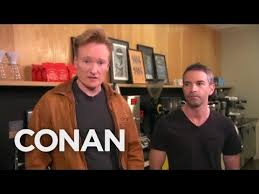 By now, everyone has likely seen the Conan coffee clip where his coffee snob employee snubs an Intelligentsia espresso. Don’t worry. Intelligentsia is laughing all the way to the bank, as the snub gave them an opportunity to put the dissenter in his place. Meanwhile, it warmed my heart to see coffee given its minute of fame (actually eight minutes of good air time). There were some genuinely funny moments in it.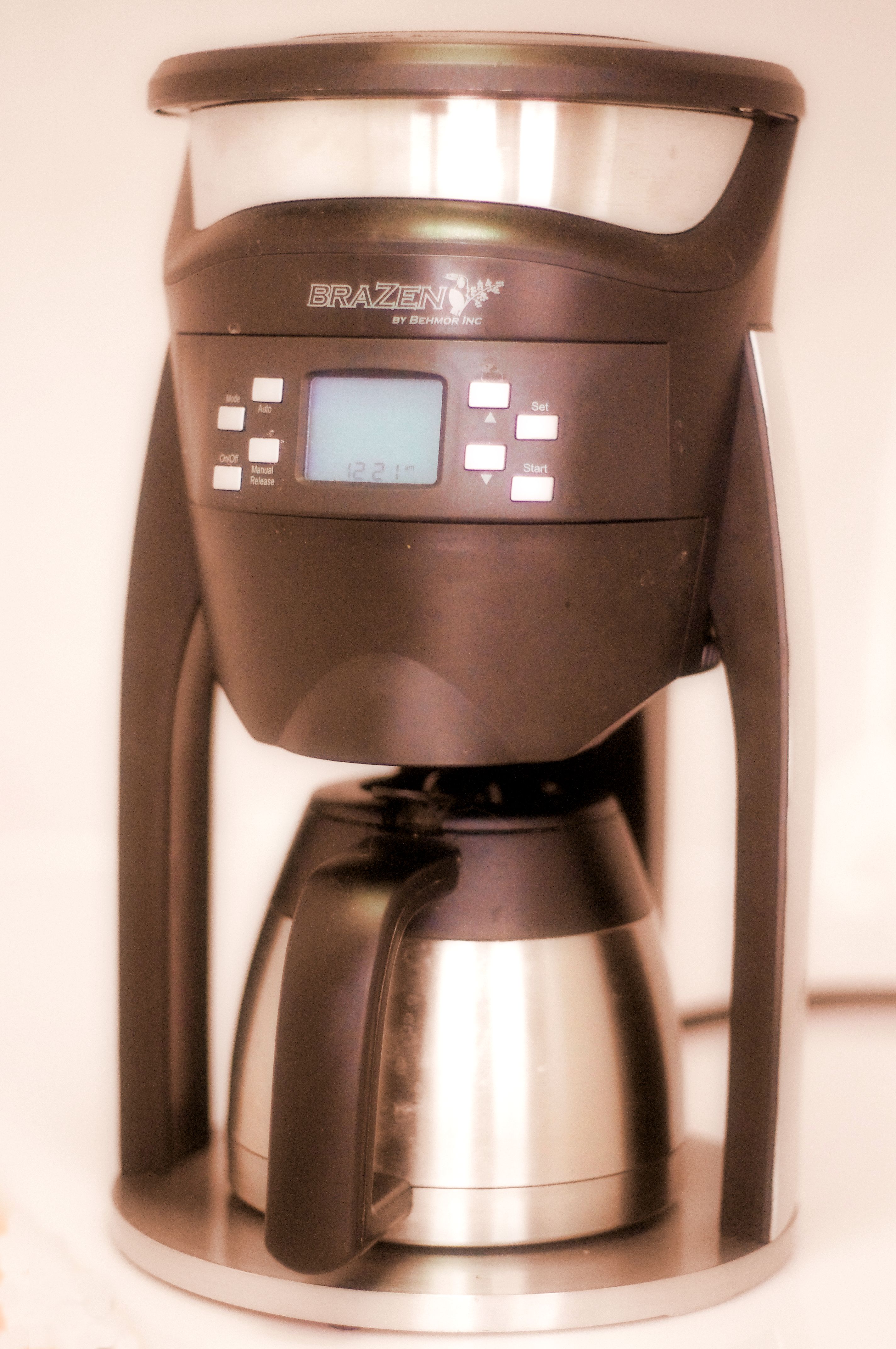
 When you pick up a bag of Kona blend coffee how much Kona coffee do you think is inside? I would guess most folks would guess around 80%. How about 50%? 10%? It may interest you to know at Safeway for years it has been an honest 5%. I say “honest” because apparently there is no real coffee blend percentage regulation.
 Bodum has always been known to produce the very best in manual drip methods especially the French Press. This year they’ve decide to take everything they’ve learned about manual drip brewing to create their own version of the automatic drip coffeemaker. While I haven’t tested this new coffeemaker yet I got a first hand demonstration at the 2012 International Housewares Show in Chicago. I can already tell you that I like the idea of the see through design that shows off the quality electronics inside.