by Coffee Kevin | Jun 16, 2016 |
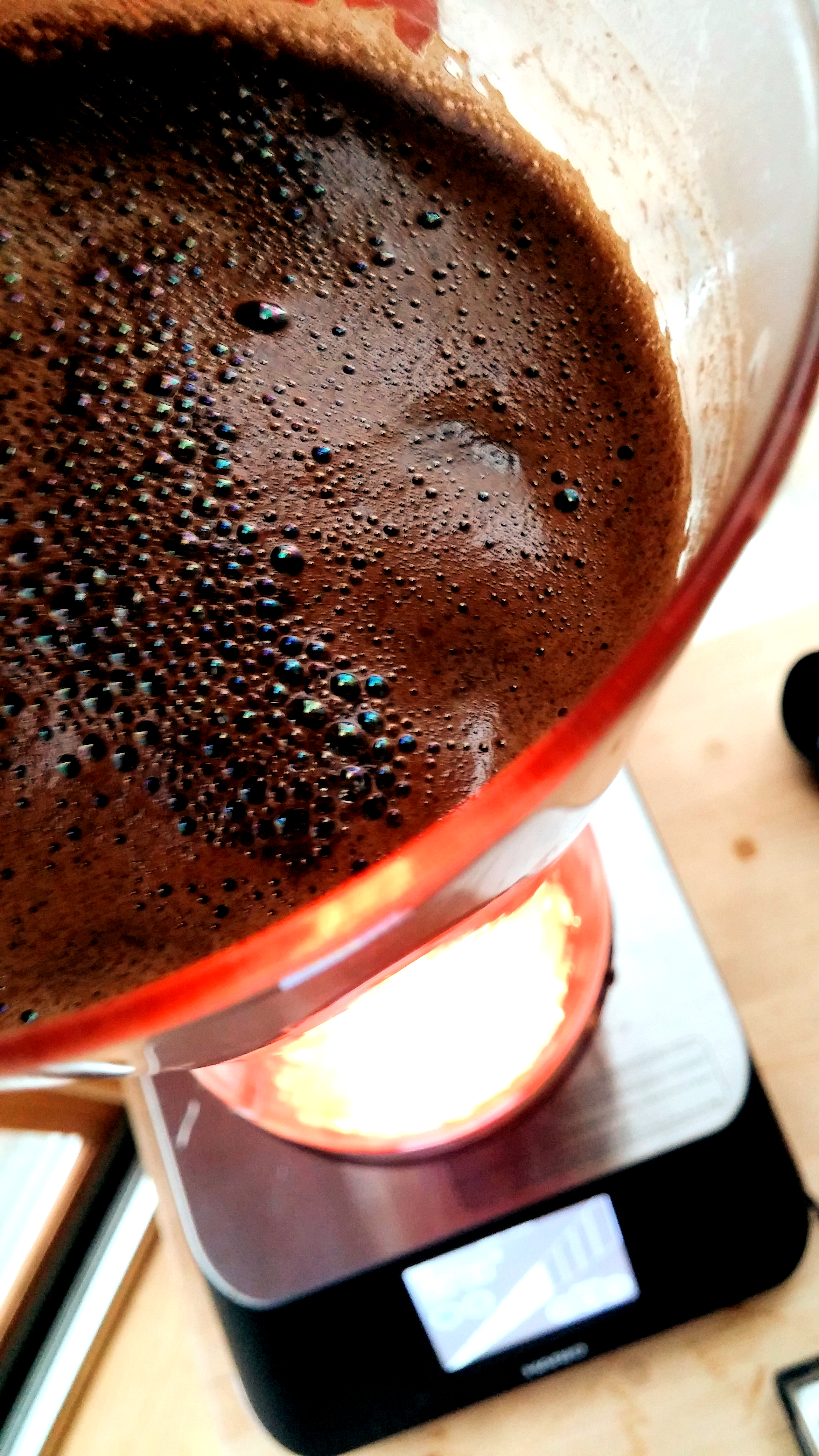
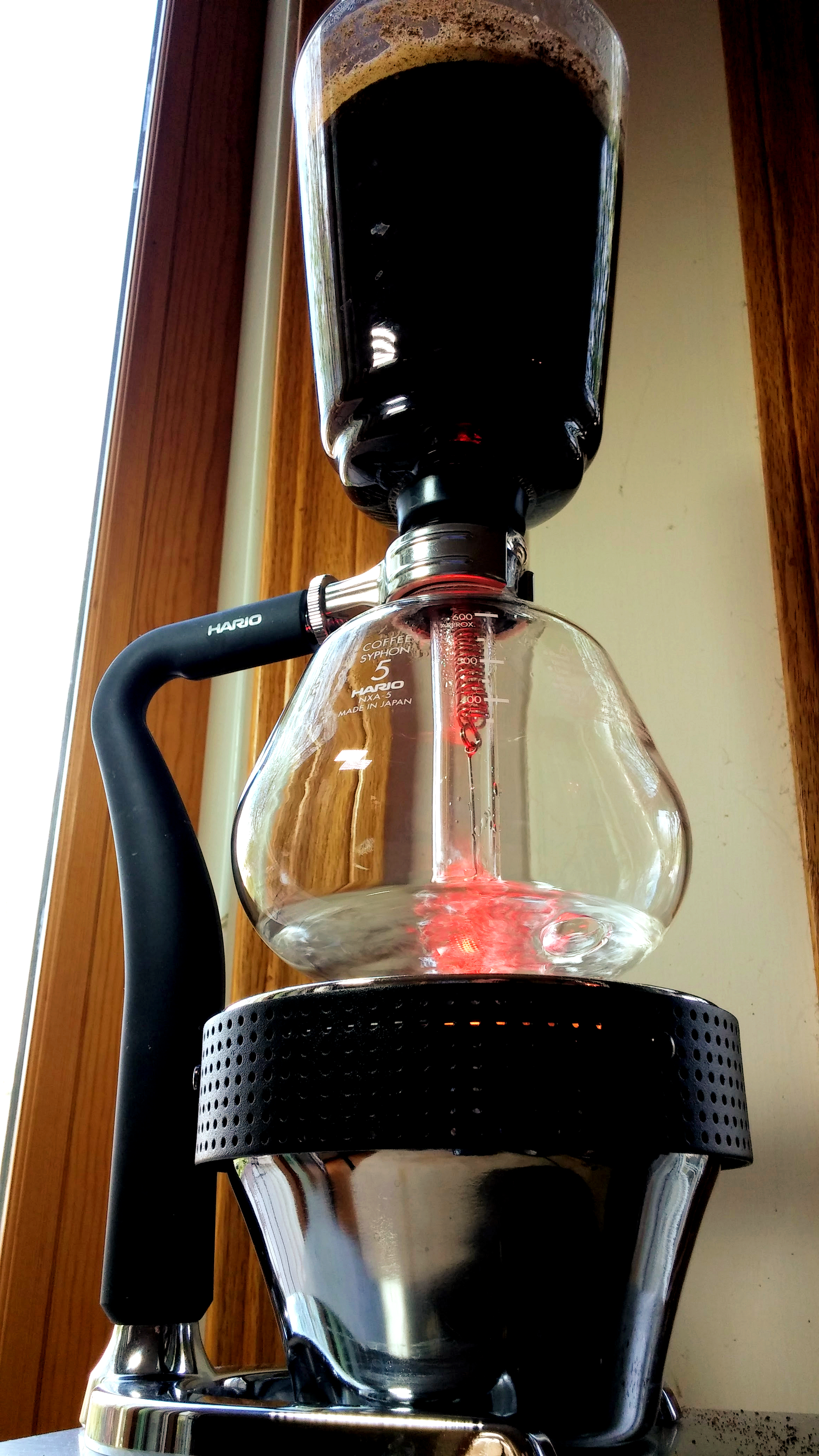
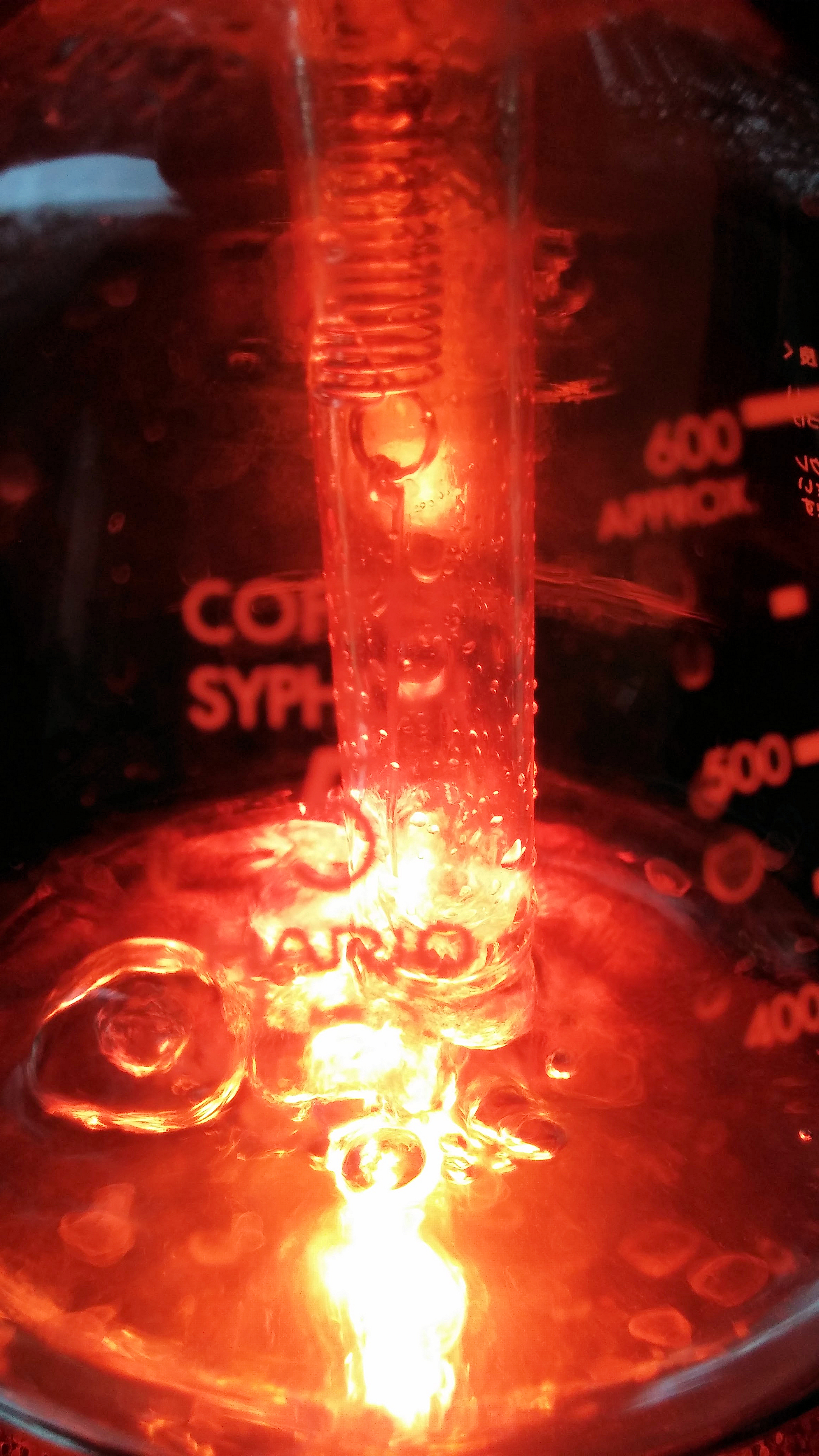
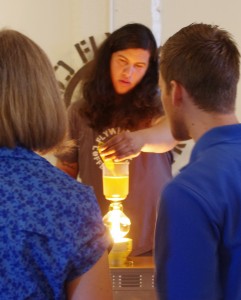 The Hario Syphon is perhaps the ultimate quality siphon, also long-known as a vacuum coffee maker. The Syphon works on the principal that near-boiling hot water in an enclosed lower vessel releases steam that expands, forces the hot water up through a tube into the upper bowl, where it is inherently the right temperature to brew coffee. As long as the lower bowl is kept heated, the water will stay up there, brewing coffee. The bubbling below causes the water in the upper bowl’s water to agitate the grounds, facilitating the extraction process. When the operator decides enough is enough, she simply removes all heat below and within about a minute the cooling and contracting vapors below cause the lower bowl to suck (hence the word vacuum) the finished brew back down into the lower bowl. Oh, did I mention there is always a filter between the two bowls? Haha, that alone is worth a patent. Siphons vary in the heating method (earliest samples were flame powered) material (glass is original and common, metal durable but no theater, plastic combines both benefits but it’s plastic) and filter type. The filter type is likely the most important of the variables to affect taste, and I’ll go into that later.
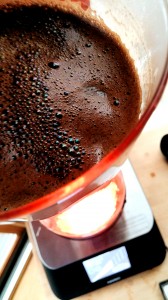 Should history ever agree to repeat itself in a different order, I’ve long felt the siphon would have been the ideal brewer to replace drip. After all, the siphon fixes the following drip issues:
- Grounds to Water Ratios remain constant when making different size batches.
- Easy to maintain in-standard brewing temperature.
- Grind is less critical because it has no effect on contact time.
There may be other benefits too. But, in an effort to keep this review from taking my record for the all-time windiest, let’s now cut to our Hario version on the test bench. It’s a beauty all right. I promise not to let looks intoxicate me, but as with my marriage, I’m a sucker for looks. And this one’s a knockout. But, can it make coffee? And how! The Hario Syphon and its companion infrared heater are amazingly competent in that ability. This is a completely professional kit for any barista. Best of all, for the well-heeled devotee, it offers perhaps the ultimate home siphon setup. 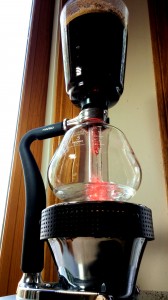 You get:
- A lower bowl on a sturdy metal stand. The glass is clearly a thick, robust, tempered type. The upper bowl’s stem (in my experience) is often prone to breakage, but with this unit so far, no such problem.
- Two filter types. You get the original cloth filter, that is most effective and (I think) the original method, offering the cleanest, clearest coffee. You also get a Hario-designed metal filter which effectively filters and apparently matches the flow rate of the cloth one, so they are interchangeable. More sediment but that’s what metal filters do. Much more convenient.
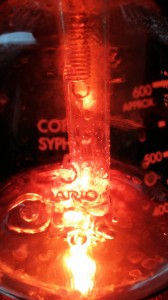
- Infrared heat. To me flames take too long, the liquid fuel is a hassle and flames vary in temperature due to air flow. To be honest, infrared still isn’t fast enough for me, but it looks beautiful and is wind resistant.
Say What You Think, Kev… I absolutely think this siphon is the best one I’ve yet used and I’ve used lots of them. It brews some of the best coffee I’ve ever had, which is saying a lot. But……… all siphon brewers I’ve yet tested have the following potential issues:
- Variable contact time. Try though I may, I find the idea of shutting off the heat and then expecting the coffee to dutifully drop back through that filter to the bottom again varies a bit. I’ve done pretty well overall. After some practice with this unit I was able to get a four minute contact time within fifteen seconds most of the time… but, not always. Compared to drip or other full immersion methods such as French press, the siphon varies more and I see no solution to this. I made one last batch before starting to write this review and I had a nearly six minute extraction. The coffee still tasted fine, but it is worth noting for those to whom it matters.
- The cloth filter is a hassle. Not this one in particular. All of them. If you’re an occasional user, it’s practically a no-go as storing the cloth filter requires cold water, a spot in the refrigerator to keep it cold, and frequent water replenishment. If you use the cloth filter often they are prone to absorbing built-up coffee tastes. The stainless filter, which I admit I used for most of my testing, allows fine sediment through. Paper, my personal filter material first choice is not an option. (Update: See below under tweaks for just such an option.)
- Heating, even with the fancy infrared heat source, is not fast. Compared to coffee brewers such as Bunn’s Phase Brew, Kitchen Aid’s KCM0802, OXO’s 12-cup Barista Brain and others that get the water to SCAA certified brew temps before contact begins, the room-to-ideal temperature on this siphon brewer using the Infrared heater is roughly ten minutes. Too long. I learned quickly to heat the water in a separate kettle first. Solves the problem and not that big a hassle, but still an extra step.
 So, recommended or not? I will never knowingly write anything but the truth in this blog. While I acknowledge that this brewer still requires more active concentration from the end user, I also know it makes some of the best coffee I’ve yet tasted. No getting around it. For ultra-fresh coffee, very good quality coffee, roasted to its more flavorful degree, the Hario Syphon does a unique job. Carefully used, you can get a very thorough extraction, full of fruit and complexity. You truly feel you are tasting deep into the coffee. So, yes, highly recommended, with the caveat that you must become part of the task of brewing it. It is not yet truly automated in this product, and if used in a way that is automated, you are, in my opinion, giving up flavor in exchange. How Do I Use It? There are lots of ways to use a siphon or vacuum brewer. Here’s my personal method.
- Heat four cups of water in an electric kettle to 200°F.
- Weigh 38 grams fresh roasted beans and grind them a coarser than auto-drip but a notch or two finer than for Chemex drip (coarse).
- Once water is heated to 200°F, transfer it to the empty glass bottom half and place on infrared heater. Turn heater on to maximum or one notch less.
- Place empty upper mixing vessel with filter inserted into lower half so that they fit snugly together.
- After water has completely risen scoop or pour grounds into top half. Very gently stir near top to ensure all grounds are wet. Start timer.
- At one minute begin another few seconds of stirring. Do not stir downward, as I found if you do, there’s a risk that some amount of brewed coffee will work itself down into the bottom half. Reduce heat a few notches after stirring.
- At two minutes stir gently again. Lower heat a notch or two.
- At three minutes, stir one last time.
- At around three-twenty, turn off heat. After a few seconds, the coffee will begin its final descent into the lower bowl, which becomes a server upon completion.
- When the coffee has completely returned to the bottom, carefully unplug the upper bowl, remove it and place it in the top coffee, which when upside down, becomes a holder for the spent grounds.
- Serve.
Tweaks
You should know that I notice a significant difference between using a cloth and metal filter. The cloth does a more thorough job removing grounds, some might say ideal, although I’ve been around coffee long enough to know that ideal is a subjective term. Let’s just say it’s my favorite. At the recent CoffeeCon NY festival I noticed Georgio’s Coffee’s Georgio Testarossa using a siphon to brew his own delicious fresh-roasted coffee. I also noticed the brew’s viscosity matched my own using the cloth filter. I asked if he was using cloth. “No, paper”, he responded. “Paper”, I exclaimed. Then he disassembled his filter to reveal how he’d cut matching circles from a Bunn filter. 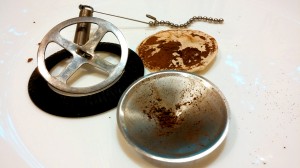 Some people use fine grind for vacuum. I used to, but lately I’ve found a coarser grind to work best. Siphons can use any grind as grind really does little to affect contact time. Of course surface area exposure affects the taste strength; that remains. Using the metal filter I find the coarse grind reduces particles in your cup. I use close to what I’d use for regular drip.
Conclusion
The Hario Syphon is a gorgeous brewer that can make state-of-the-art coffee. I had both the single-knob and digital control base units. I found each to work well. The digital control unit will appeal to anyone who enjoys its programmable features, although to be honest, I didn’t explore them. Different article. The filter options are enough to make me choose this vacuum unit. I never felt the glass was fragile and had no incidents nor near-incidents during my tests. About the only thing missing compared to drip pour-over such as a Hario V60 is the ease of controlling brewing temperature. Vacuum/siphon is high-temperature brewing, inherent in the process. But the results are impressive. Any time during my time with this unit that anyone came to visit they immediately noticed the unit. Whenever I offered to make coffee and asked if they had a preference, the unanimous response was to point directly at the Syphon and say, “That one!”
Unhesitatingly, highly recommended.
by Coffee Kevin | Apr 6, 2016 |
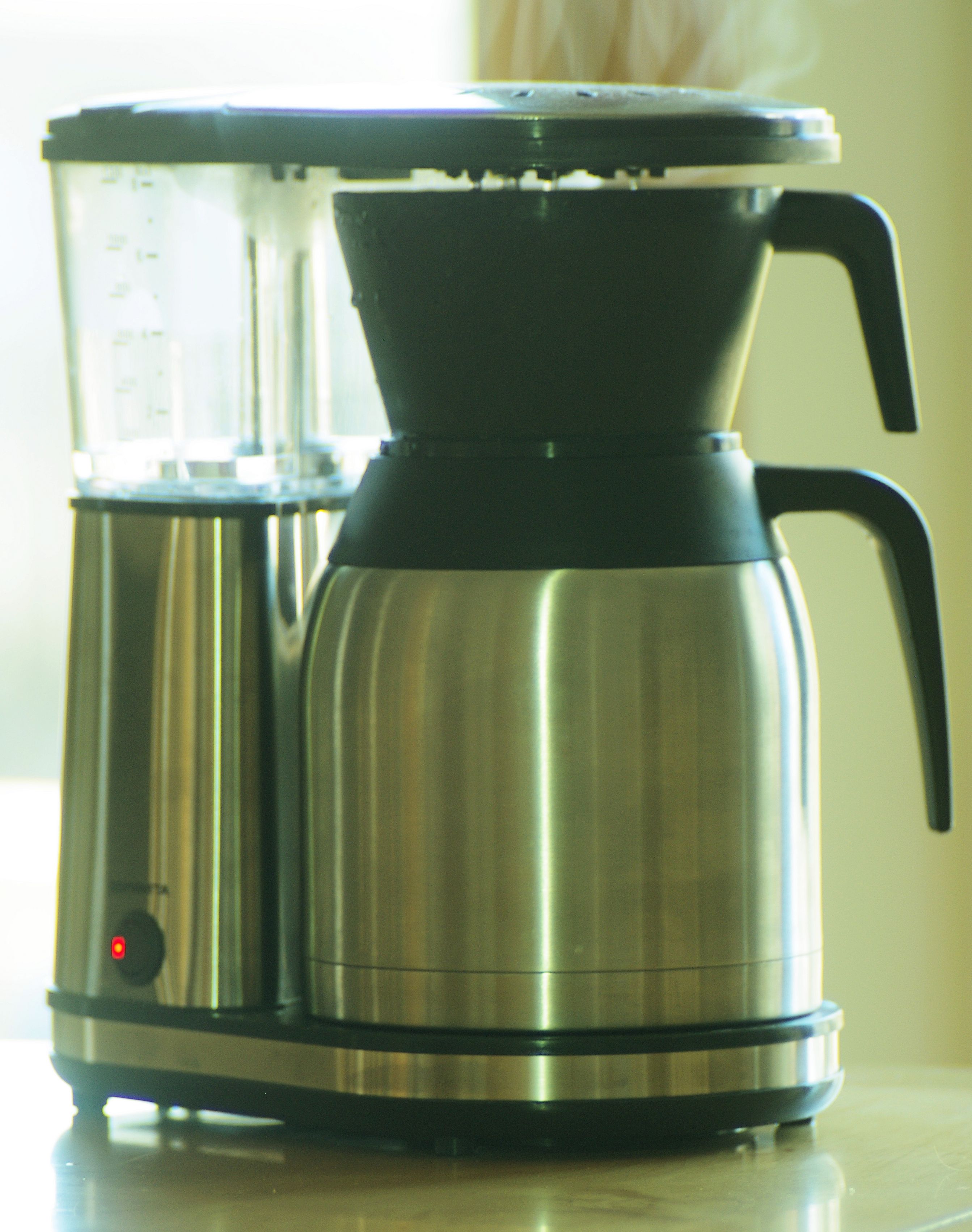
The Bonavita coffee makers are the current coffee maker for everyman. They are easy to use, forgiving of those who do not self-identify as geeks; those of us who just want to scoop our grounds in, fill with water and press go. Bonavita coffee makers were originally Melitta units, the first generation designed in Germany by Melitta, who license their brand name to Hamilton Beach in the US.
Espresso Supply distributes them and, when Espresso Supply took over their distribution, I had my doubts. Their background is, as the name implies, espresso. They have a separate line of manual brewers, including a widely used variable temperature kettle. They had no experience with electrics. Yet, the public and cafes seem delighted with this company’s approach.
What Espresso Supply is, is dedicated to brewing coffee. This means they really seem to understand both the consumer (you and me) and the process, and it shows in just about everything they do. I met Chris Legler, their Financial Strategist, a few years ago now. Now, if you know me, you’ll know this is a role I would usually dismiss as one of the suits, about as useful to know as Human Resources. As I got to know Chris, I developed a lot of respect for his devotion to coffee and brewing. I came to learn he worked for Sony, a company I long ago admired for their understanding of their audience and both sound and visual products, at least in their heyday.
I see Chris the same way, and I invite you to eavesdrop on a more or less typical conversation between us about brewing. Note: He has no problem discussing any brand of coffee product. He realizes we’re discussing something bigger and has that sense of history not often found in corporate cultures. And, he actually seems to use his (and everyone’s) coffee brewing products!
This podcast was recorded at the NCA Conference in San Diego in March, 2016. Thanks to Joe DeRupo, NCA’s Director of External Relations and Communication, who provided the recording space.
Podcast: Play in new window | Download
Subscribe: Android | Email |
by Coffee Kevin | Mar 7, 2016 |
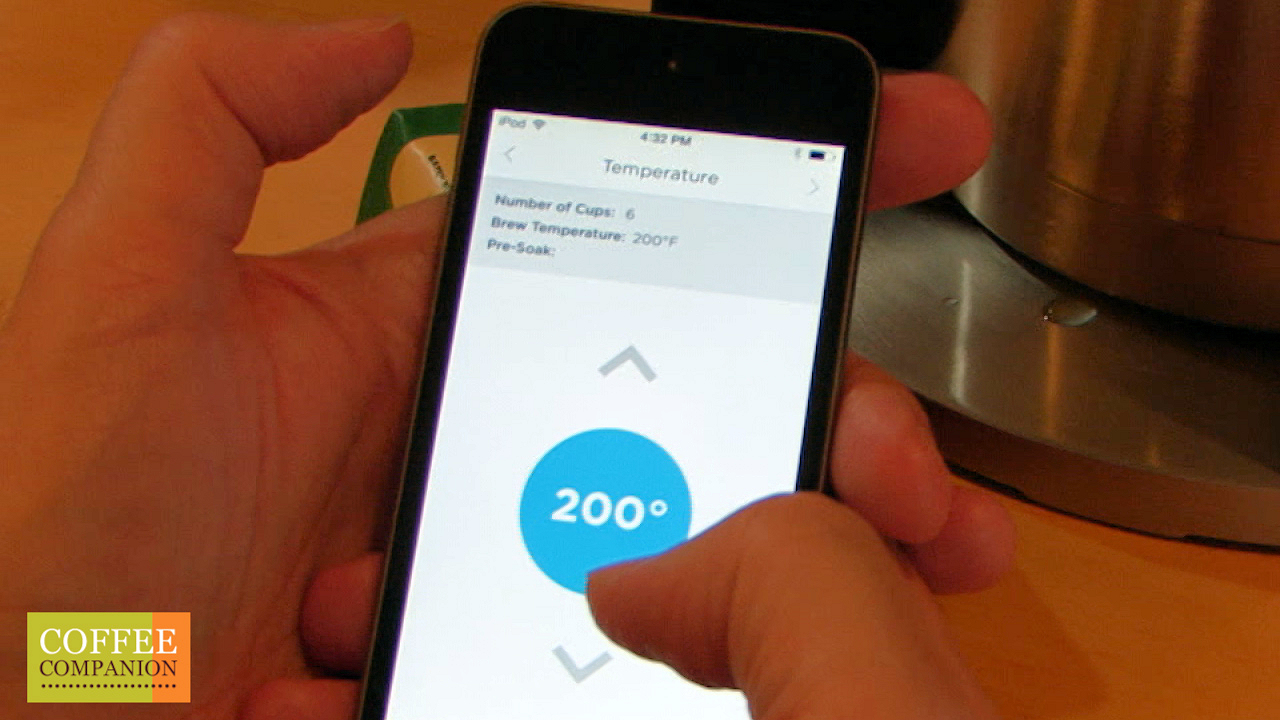
 The Behmor Brazen was the most advanced coffee brewer I’ve ever tested, until this new Connected version came along. Joe Behm continues to innovate, always a step ahead of others who rush to implement his ideas. The big splash about this latest version is the ability to use your iPhone or Android to operate it. But, more important to me is the availability of the roasters to create downloadable brewing parameters so that we can begin to taste the morning cup George Howell, Klatch’s Mike Perry or Equator’s Helen Russell has. Altitude adjustment, adjustable brewing temperature, pre-infusion options. What are these and what do they mean to our coffee’s taste?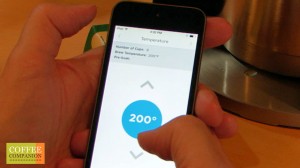
Todd Larrabee is Marketing VP for Behmor. He brought a spanking new Brazen Connected to my house and we enjoyed coffee as he explained what this brewing is about and how it can close the loop between what your roasters achieves in beans and your final cup of coffee produced by this machine.
Podcast: Play in new window | Download
Subscribe: Android | Email |
by Coffee Kevin | Mar 4, 2016 |
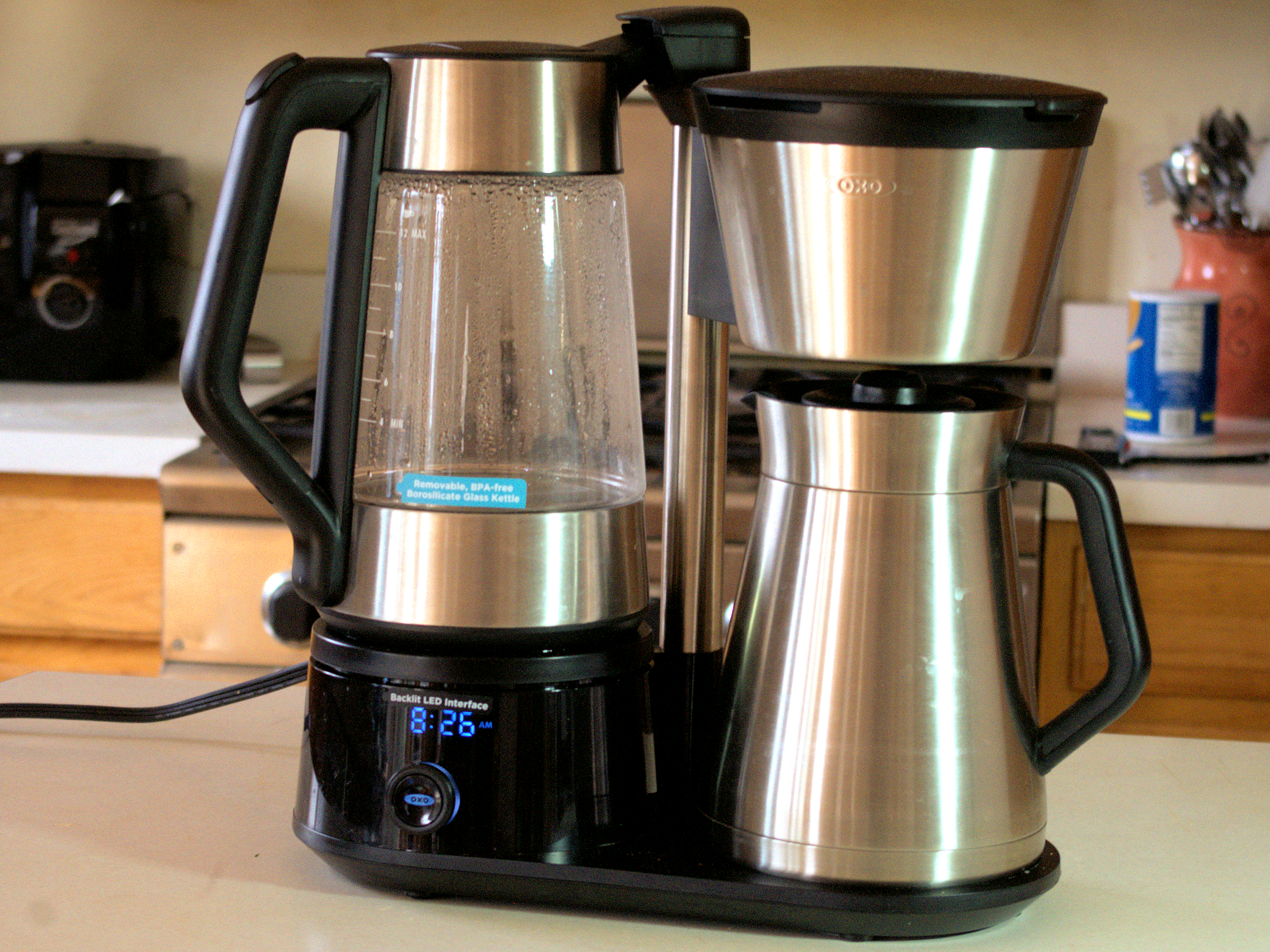
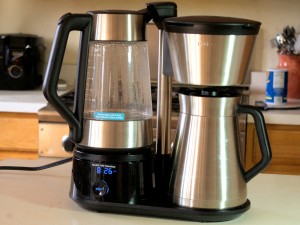 Once upon a time, the way to brew 12 cups of coffee at one sitting was owned by Bunn and its use of always-hot water to make it possible to deliver 200°F (+/-5°) water to a grounds basket and run it through the grounds in an impressive three minute window. A consumer falling-out with the standby mode and a misunderstanding of contact time by consumers, retail appliance buyers and Bunn’s competitors caused these units to be discarded, although if you look through Bunn’s current lineup, there may be a brewer in there that still follows this general principle. But, I’m unnecessarily distracting you from our guest of honor and that’s this new OXO machine, which solves a few of the problems and limitations of earlier big batch consumer brewers, and is at once a leader in this category. Let’s go through its features and then discover how it does in actual kitchen testing and tasting.
- Batch Size = real 12 cups – This brewer makes an actual 12 cups of coffee and they went with the larger 5 ounce cup size, not some metric variant claimed to be from Europe, which translates into four ounces or less in order to create false confidence. If you have 12 guests or a half-dozen who’d like a second cup, you’re in for a treat.
- Water heater/Kettle – through an ingenious design, OXO has created a water heater that’s removable and can be used as a separate kettle.
- Water scale – the kettle is actually sitting on a scale that automatically weighs the water and selects the batch size.
- Adjustment of drip parameters to accommodate various batch sizes.
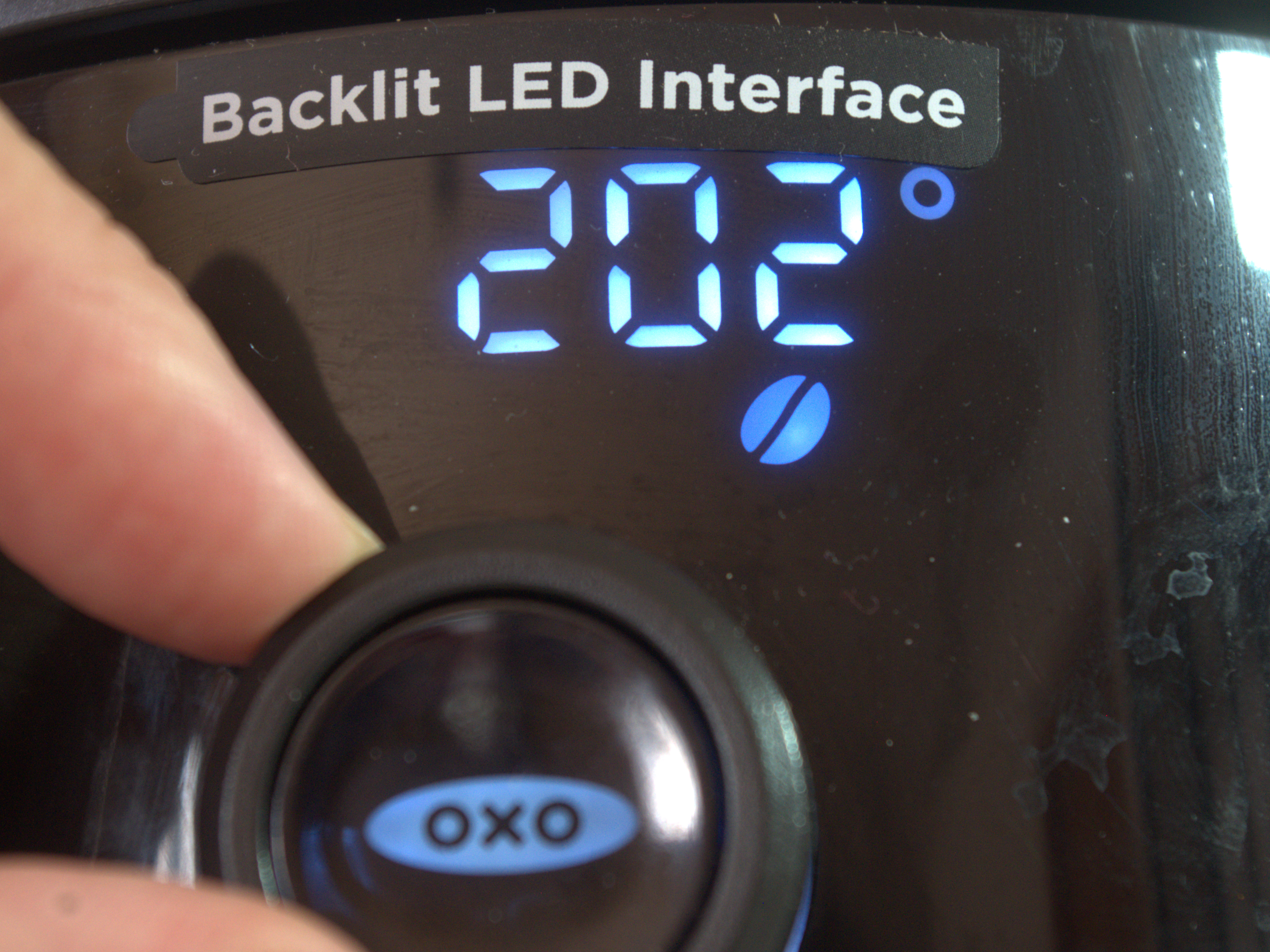
- Brewing temperature adjustment. This is a big benefit, and more about it later.
How does it all perform?
- Batch size – works well in that, as mentioned before, honestly calls a cup a cup.
- Water Kettle – it works like it says it does and gives the consumer two appliances they might normally need, which goes some to make up for the brewer’s somewhat larger than usual footprint.
- Water scale – works well and fooled me. I forgot about it a few times and didn’t trust it to choose the batch size. Once I got comfortable with its doing this step for me, things were easy.
- Adjustment of drip parameters – no matter what batch size I chose, the contact time was three minutes. This is actually a bit fast for those used to Chemex or most other automatic drip coffee makers. You might consider a slightly finer than usual grind in order to ensure your coffee is fully extracted. But, yes, it works, and I’m still not sure quite how, as I can’t really see inside the brewer while it’s functioning.
- Brewing temperature adjustment – This is a wonderful feature, especially for those of us spoiled by using our own temperature adjustable kettles when brewing manually. I found 198°F to work ideally when brewing Metropolis Coffee’s Honduras from Mario Doreteo Perez at Finca Guamilito. When I brewed Old Soul’s Papua New Guinea – Aiyura Plantation coffee, I found 202°F really brought forth the bright notes in this surprisingly fruity Indonesian coffee.
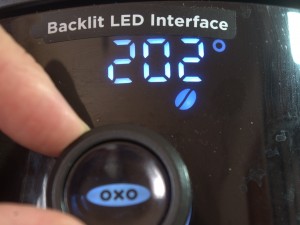
Tasting tests I’m in a testing phase right now with several (including a second OXO model) other brewers on the bench. I had one coffee in house, the aforementioned Metropolis Honduras from Mario Doreteo Perez. Fortunately, it is a very fine one. Its beautiful fruit and nut notes came through loud and clear with this maker. As I’ve found with most shorter-extraction-time brewers, the bitterness really gets down to the null point. So did even the two degrees below 200°F as a brewing temperature. 198°F just offers a little more fruit, a little less tang. It’s a well-known trade secret that different beans and roasts perform optimally at different temperatures. The great news is if you can play with this or not; it’s up to you. We used this brewer for several large family gatherings over the holidays and I found it very easy to use and deliver a large batch of delicious coffee. I had to get used to turning it on, as you need to turn the knob to brew so it doesn’t just boil water for its other role, but once you get used to it, it’s really quite intuitive. I was worried that the cupcake filters I found at the supermarket would be undersized, especially given the rather short contact time. Yet, the coffee level, while extremely close, never rose above the line and overflowed inside the basket, a sign of good engineering. Notes: I notice OXO chose a cupcake/flat bottomed filter for this brewer. I have always preferred this filter style. While there are V-shaped filter brewers that meet their specs and brew fine coffee, I think the flat-bottom style does the most to prevent an over-extraction point in the brew basket. It does require 12-cup filters, and ideally you can find these at a restaurant supply house, where they should be, if anything, less expensive per brew than v-style filters from a grocer.
The decision to have the brewer start from cold instead of a constant always-on mode is likely a good one. The fact is it still means only about a twelve minute start-to-finish brewing time and that means it rivals many other twelve cup automatic machines, and many of those never reach the optimum brew temperature, and meanwhile over-extract as they start right away (tepid water and all) and extend the contact time throughout the twelve minute brew cycle. My best brewing results occurred using the full batch recipe of 100 grams medium fine grind coffeee, slightly coarser than I would grind for say a v-shaped filter try automatic drip brewer such as a Technivorm. I realize the OXO uses a shorter duration contact time between water and grounds, and so it is counter-intuitive, but I’m just reporting culinary taste results, not attempting to justify them. Your mileage may vary and I always encourage others to tweak theirs and report back. Conclusion – If this is OXO’s first effort, it is a very good one. Apparently the Specialty Coffee Association agrees with me, as they certified it, not bad for a first effort. haha Simply, I would put the OXO 12-cup at the top of my list for a twelve cup automatic drip brewer. Highly recommended.
by Coffee Kevin | Nov 27, 2015 |
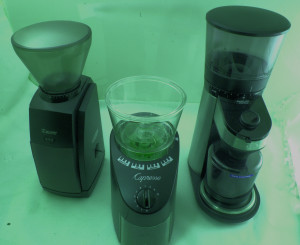 The missing mystery element in brewing is the grinder. There. I said it. Just like every heart doctor wonders if their newly released open-heart patient will exercise, every priest wonders if the just-forgiven sinner will truly repent and change their lifestyle, the coffee roaster must wonder how you’ll grind their beautiful fresh beans before brewing. To accomplish this you must have a good grinder. The word ‘good’ means it can effectively divide the bean into evenly-sized close-to-the-same-shape particles, and be as free as possible of the powdered particles the industry calls “pan”.
I often say that you can make excellent coffee using a simple Melitta manual drip cone, which retails (with a ceramic mug) for around $10. But, a grinder, now that’s a different story. Grinders at the lowest price end simply don’t perform well enough to be a fully functioning member of Team Coffee Brewing. Why is this? Let’s take it away from coffee to explain. If you’re making a stir fry, you know you must strive to consistently cut the vegetables. The reason you want them the same size is the heat will affect them evenly if they are. You’ll get cooked, crunchy vegetables. If they aren’t evenly sized, extremely large pieces won’t cook through and small ones will be overcooked.
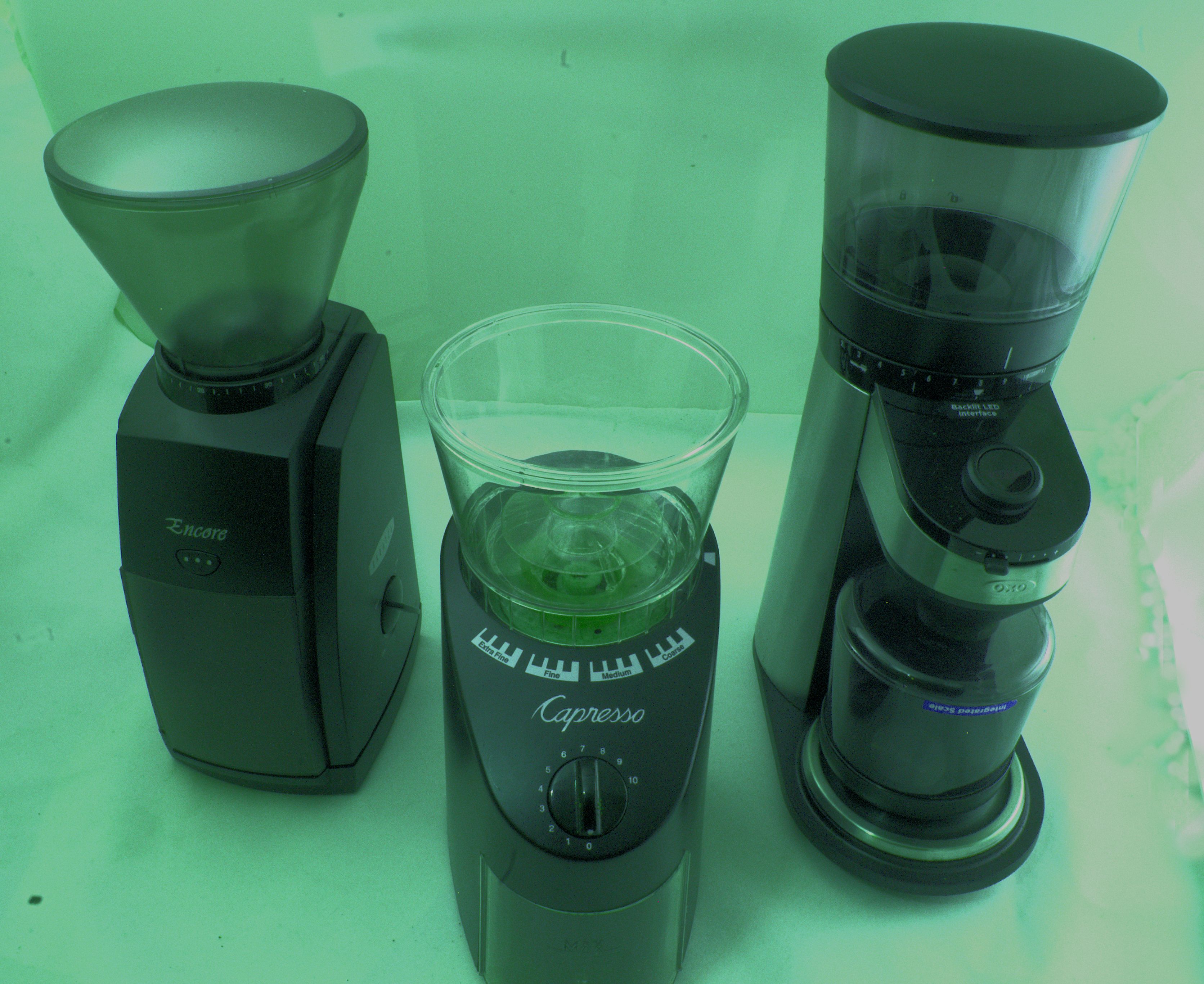
In ideal coffee grinding, the pieces will also be the same size. This is necessary because contact time is identical for all those pieces. Larger pieces cause waste; you are not getting all their flavor; too small pieces will be over-extracted and dreaded bitterness occurs. The best grinders are produce grind size uniformity. The worst performing grinders are blade grinders. It is impossible to expect otherwise, as the blade is spinning and the beans are repeatedly and randomly struck. To expect any kind of uniformity is to expect order from chaos. Most readers here are not surprised at anything I’ve so far said, so let’s get going into examining these three grinders. They are all known as entry level, meaning they are lost-cost, but they are from well-regarded manufacturers serving the specialty coffee market.
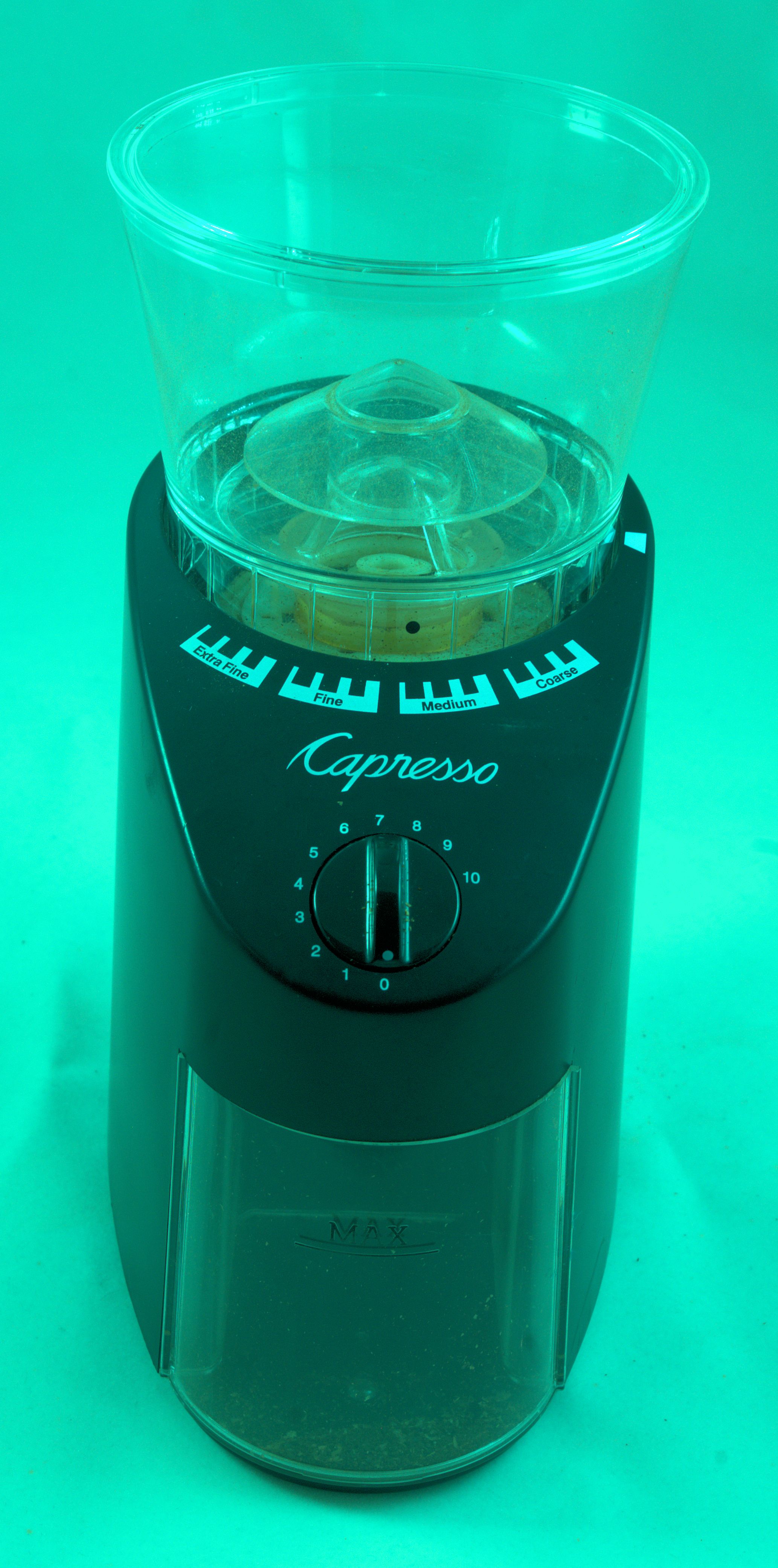
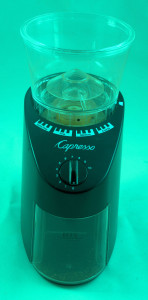 Capresso Infinity 560 Stainless Steel Conical Burr Grinder $99 The first one is from Capresso. Capresso actually has a long history in this product category. Started in the 1990s by Michael Kramm, an ex-Krups executive and now retired, Capresso went around and scooped up ex-Krups vendors and created some new and innovative products. Some are excellent and others are, in my opinion, okay but nothing special. This grinder was recommended to me by Michael himself, who while no longer working at Capresso, apparently still follows them and thought highly of it. I requested a sample and have been using it quite a while before being able to test it.
NOTE: There are two very similar Capresso grinder products. What differentiates them is the burr material, which does the actual grinding. One is ceramic. The other stainless steel. My industry contacts have told me that stainless is generally acknowledged to grind more consistently at coarser (medium drip through French Press) grinds. I asked for Capresso’s stainless steel grinder.
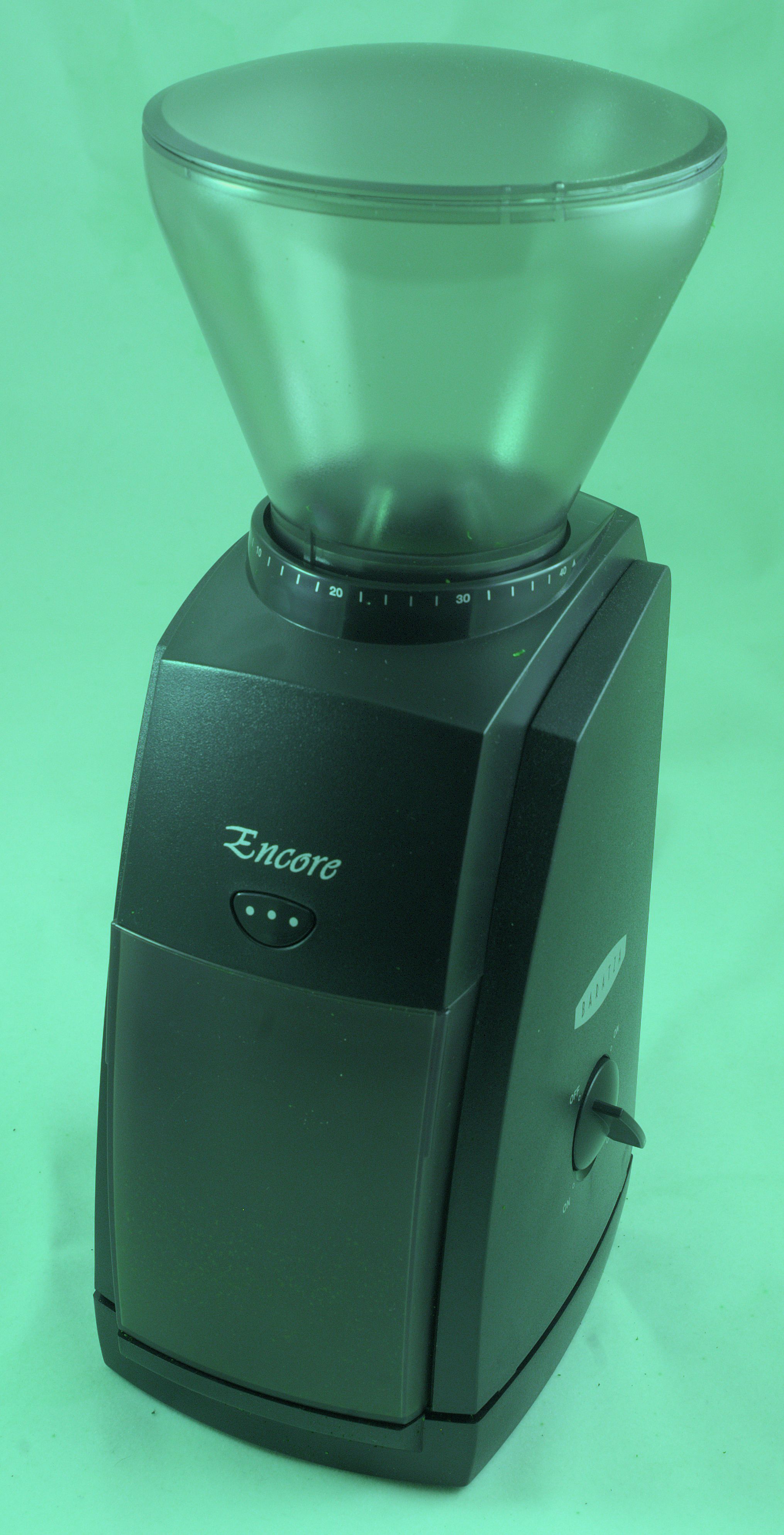
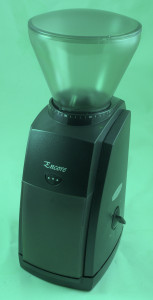 Baratza Encore Conical Burr Grinder $129 The second model is from Baratza. Baratza practically owns the grinder market in the specialty world. Industry regard for their products is high enough that many shops use their costlier grinders, even though they are clearly aimed at consumers. While I’ve always assumed Baratza makes their grinders, I’ve noticed multiple countries of origin credited on their products. Do they really have multiple plants, or are they outsourcing? The model I tested is made in Taiwan, and uses a different burr set from the pricier Virtuoso models. However, Baratza is the leader and I was half expecting it to shame both the others, based upon their company’s reputation.
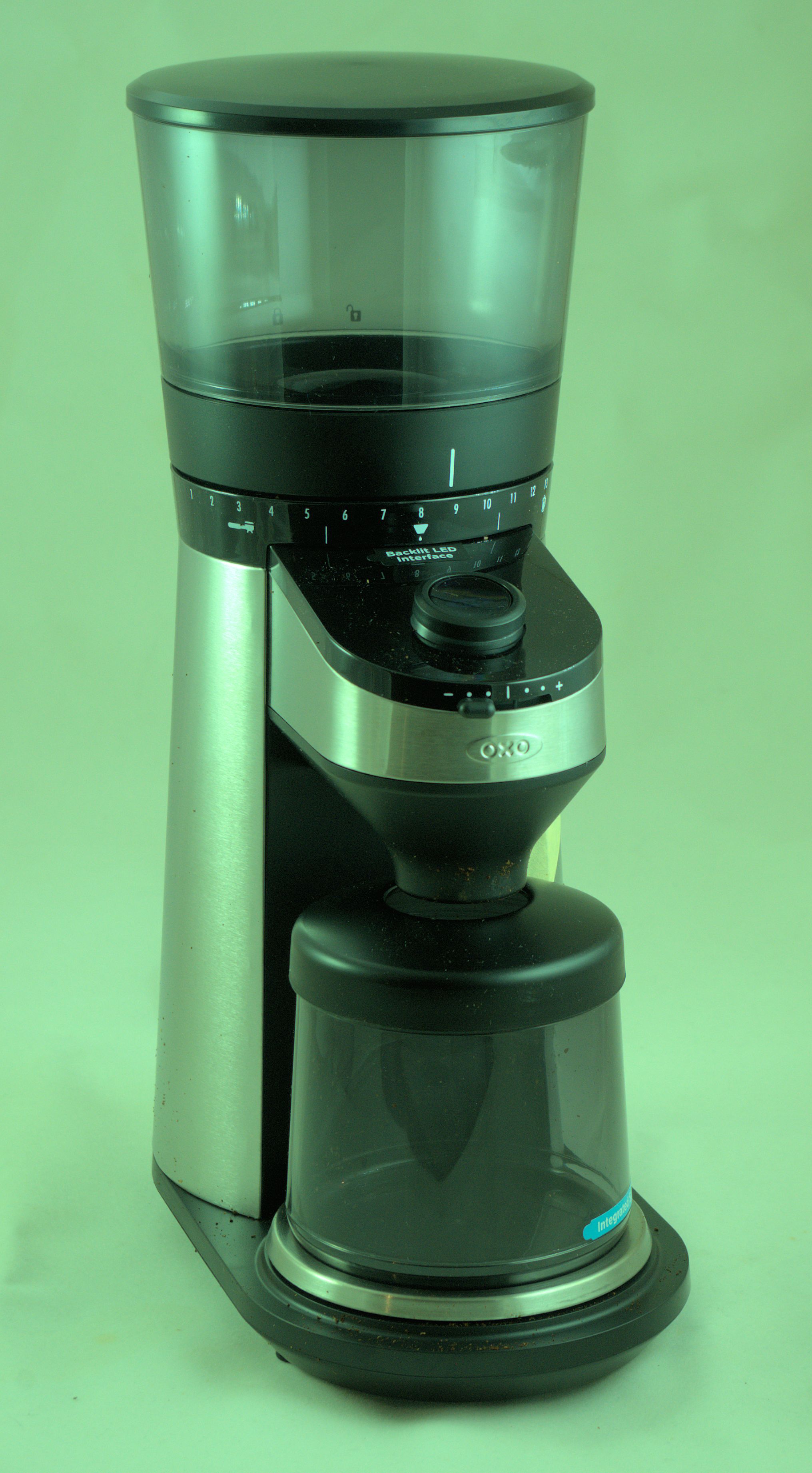
OXO ON Conical Burr Grinder $199 The final model I tested is from the new kid on the coffee gear block, but one you’ve no doubt heard of in their other categories: OXO makes those soft-handled kitchen gadgets that populate the kitchen hand tools section at Bed, Bath and Beyond. Suffice it to say I was more than a little surprised when I spied OXO at last year’s International Housewares Show brandishing prototypes for both coffee brewers and a grinder! Before these tests I had no impression of OXO’s design or manufacturing prowess. I owned but a single product of theirs; a non-powered can opener. Needless to say I was eager to test their first grinder.
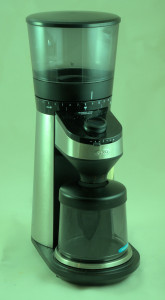 Features compared All three of these grinders are more similar than dissimilar. They all feature simple overhead bins where beans can be stored and twist gauges to adjust fineness. The OXO grinder has one feature that is unique, even when compared to many costlier grinders than the others in this survey; An onboard scale.
Build quality and feel Again all three are similar, in that I could not predict which if any would fall apart or lose its ability to meet specifications by a certain date. If I were to nitpick, I’d suggest the Capresso had a slightly ‘plastic’ feel to it, but I’m not at all sure that another tester would feel the same way. Might be my taste. This is good news because it makes it simple to compare and decide for the right reason: which one grinds coffee the best!
Grind tests I brought all three to Modern Process. Modern Process makes many of the world’s industrial grinders. Name a large roasting plant that packages pre-ground coffee and I bet you they use grinders from this company. I’ve known Dan Ephraim, their CEO since I first wished to write about coffee. He was literally the first industry person I met. We are friends and he and his tester, Rasmy, conducted several tests with each grinder, using beans from Euro Coffee in Los Angeles. Then, each sample was place in a ro-tap device. In case you’re new to testing grinders, this device is a series of screens. The idea is to analyze what percentage of grounds are what size, so we can compare grinders to a theoretically perfect standard and also between each other. The best grinder is going to be one that has the largest majority of grinds that are the ideal size, with smaller percentages of smaller and larger sized ones. We set each grinder for what we all agreed by eye was a drip grind. The best grinder in this test was the Capresso. But, just as significantly, the others were darn close.
Conclusion I could live with any of these three grinders. They are all good choices. I was surprised at how similar, rather than different they performed. Baratza has done a good job with their entry level grinder, but it is not superior to either of the others. The OXO has the very useful scale feature, which will be a deciding factor for some, and helps simplify the measuring process, where many mistakes are made, so it is fairly associated with quality. Capresso leads the pack in both grind quality and price. Considering I’ve owned it the longest and used it quite a bit, it’s already proven its longevity and value. Just a few years ago, coffee enthusiasts would justly complain that there were few grinder options for the less well-heeled. Thanks in part to these three brands, this is no longer the case.
#Capresso
by Coffee Kevin | Feb 7, 2015 |
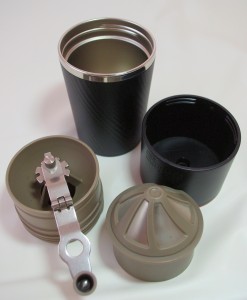 We need a traveling coffeemaker. It may just be a romantic thought, but it’s as if coffee enthusiasts are always planning to travel and don’t wish to be way from a favorite method, or at least the ability to brew coffee at their same usual high standards. In this spirit is the Cafflano Klassic designed.
There is also a need for an at-home or at-work one or two cup brewer. Every morning I brew a larger batch, but there are times during the day when one person wants a cup of coffee. I tend to make a cup at four, and I usually offer one to whomever I’m with. The Cafflano Klassic fills this bill nicely as well.
First, it is designed much like a thermos. It resembles the one you had as a kid to keep your milk cold. It completely screws together. You can easily place it in a suitcase, or toss it into the trunk of your car and know it will arrive still-assembled. Second, it is truly a coffee brewing system. It has everything you need to make coffee, except a water heater. More on that in a moment.
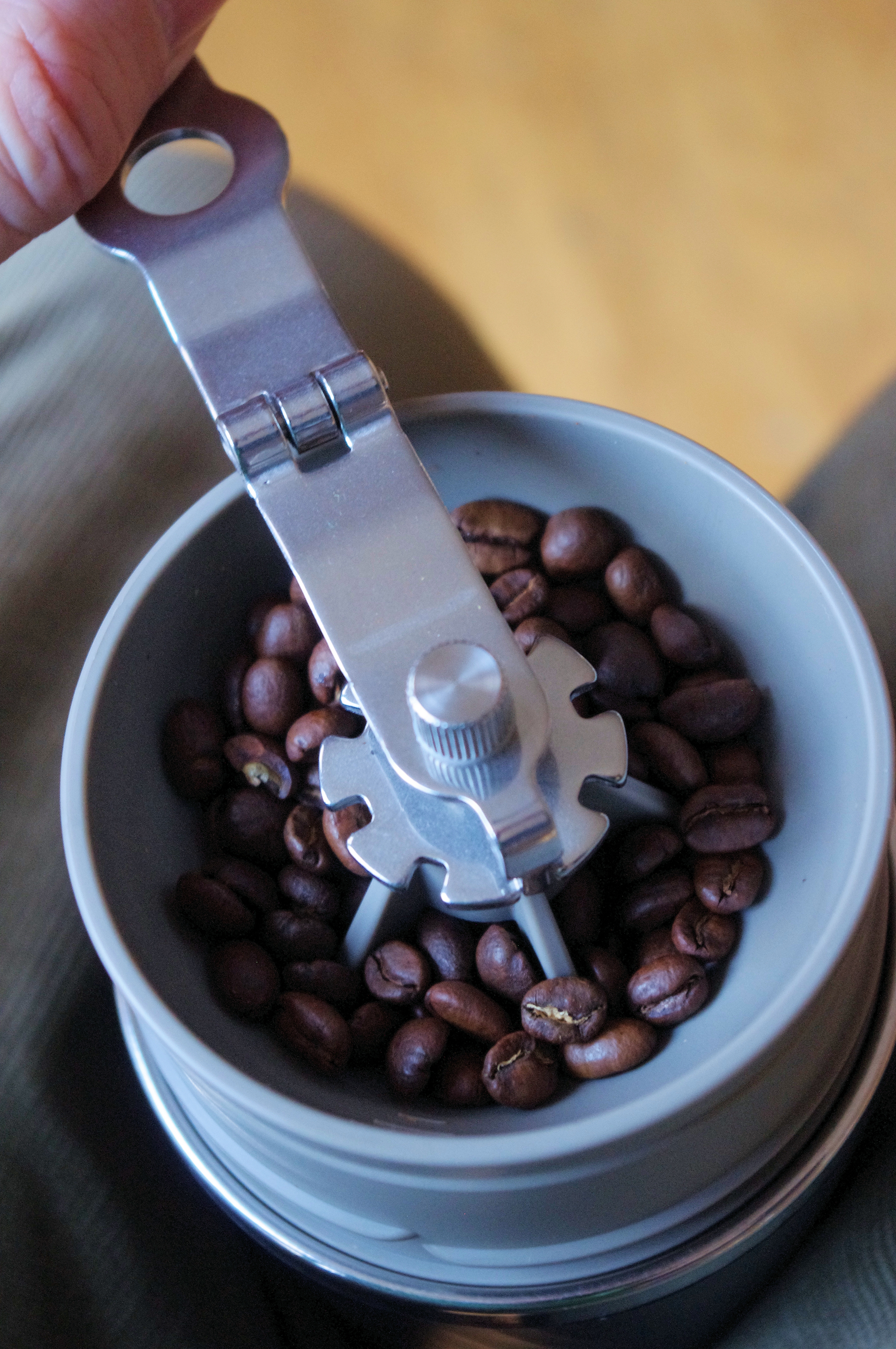
The operation is simple and intuitive. If you remove the top cap, that appears to be a water boiling vessel. Directly underneath is a hand-operated coffee grinder. Remove the grinder and you have a metal cone filter, and under that, is the coffee server. You literally make coffee by performing a striptease. Haha. Not really of course, but it is a nice, simple design.
Now, that top lid. While it looks like it is a kettle, you’d fill with water and pop into a microwave, its designer quickly corrected me when I asked about it. “While it is BPA Free, we would be concerned about possible molecular restructuring a microwave might perform and therefore recommend an external water kettle to heat your water. I respect their forthrightness and the purity in their view, but I must say the top cap even has what appears to be an exit hole to pour water over the grounds, but since it works against any claims of complete self-containment, I respect them for this.
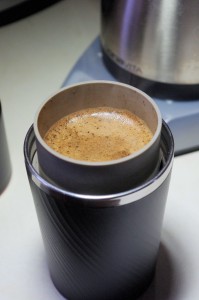 Note: I received a prototype. Its designers told me that the production model will be improved, if anything.
Operation: Simple, intuitive and hot
The Cafflano Klassic is intuitive. You operated it by taking it apart. You can place it on a scale, zero it, and add 20 grams of coffee beans. Grind them, remove the grinder and they’ll already be loaded into the screened drip filter, stored below the grinder. I feel this is a key to this brewer’s greatness, as it removes any complexity which could otherwise drive an end user to other less-capable methods.
Then, you simply add hot water in steps, just as you would in any drip maker. I tweaked the grinder until I got a six-minute start-to-finish contact time between the water and ground coffee. The closed design meant that finished coffee was quite hot, on par with that of an automatic drip maker, which is a good thing. I received an urgent phone call during one test; it was ten minutes before I got back to drink my coffee. It was still piping hot. The built in grinder is also an important part of the Cafflano Klassic’s gestalt. It would never occur to anyone to use pre-ground coffee. It’s assumed, which is as it should be.
Some may ask: “How do I set the grinder?” I simply moved it by notches until I found it took six minutes for the coffee to be brewed. This is the ideal contact time for a drip coffeemaker. If you like it a little less strong, move it another notch coarser. I like the notches. I have a Zassenhaus manual hand grinder and, while it does a nice job and its mechanism is fine, it has a free-floating adjustment screw. It drifts and for something as important as a grinder, I prefer a locking stop, such as the Cafflano Klassic features.
I used a recipe of 20 grams weighed coffee per 12 ounces of water. You will want to use a kettle, empty it and add the exact amount of water to boil, because you can’t see into the plastic reservoir.
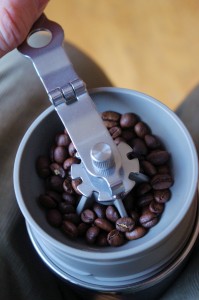 This is just a wonderful product. It does exactly what’s promised. It has a true, high-quality burr grinder. The torque, or balance between how often you must turn the grinder and its resistance while turning, is well proportioned, so grinding is less of a chore. The brewer’s design keeps the coffee enclosed and hot as it brews. The permanent filter is well made and filters all but a slight amount of very fine grounds, just enough to add a slight cloud to your coffee. I think most people will simply see it as a sign of thorough extraction and getting all the flavor in their cup. Fit and finish is first rate.
A couple of outstanding tastings:
Gorilla Coffee El Salvador La Esperanza – an old-growth bourbon coffee from one of the new hot NYC roasters, this coffee claims are cashew and red plum. I got a distinctively citrus note of some kind, but cashew was the furthest thing from my mind. However, the roast for a drip coffee was just about perfect. And the Cafflano Klassic just brought out the essence of that roast in spades.
Hapuna Espresso Blend – Surprise of the tasting, as I took the label too literally. This blend gave me one of my favorite taste experiences with this the Cafflano Klassic brewer. Kona, African and Indonesian beans roll into a delicious coffee cocktail.
Broadcast Coffee Roasters Guatemala La Hermosa – Honeysuckle, Milk Chocolate and Strawberry notes abound. The brewer just nails it. I got everything the roaster claimed it would have, and more.
Conclusion
This is the hardest kind of review. Everything works as planned. It’s a brewer that you will want to have for travel, for the afternoon one or two cups. Everything’s laid out so intuitively you won’t need to read the manual.
Highly recommended.
Pros –
• Easy to use
• Freshness built into product design
• Keeps coffee nice and hot until you use it
• Click stops on grinder (biggie)
• True high-quality burr grinder
• Permanent metal filter, high quality
• High overall build quality
• Easy carrying, quite portable
• Grinder torque smooth and easy to operate
• Simple to operate
Cons –
• Must be carefully cleaned afterwards
• Not truly independent – you need a third-party water heater
• Manufacturer made water boiler half from safe, microwaveable plastic, but still doesn’t recommend it.
• Need to measure water volume in advance of brewing. You can’t tell how much water is enough.
Neutral observations
• More silt than paper-filtered Aeropress – matter of opinion
by Coffee Kevin | Jan 25, 2015 |
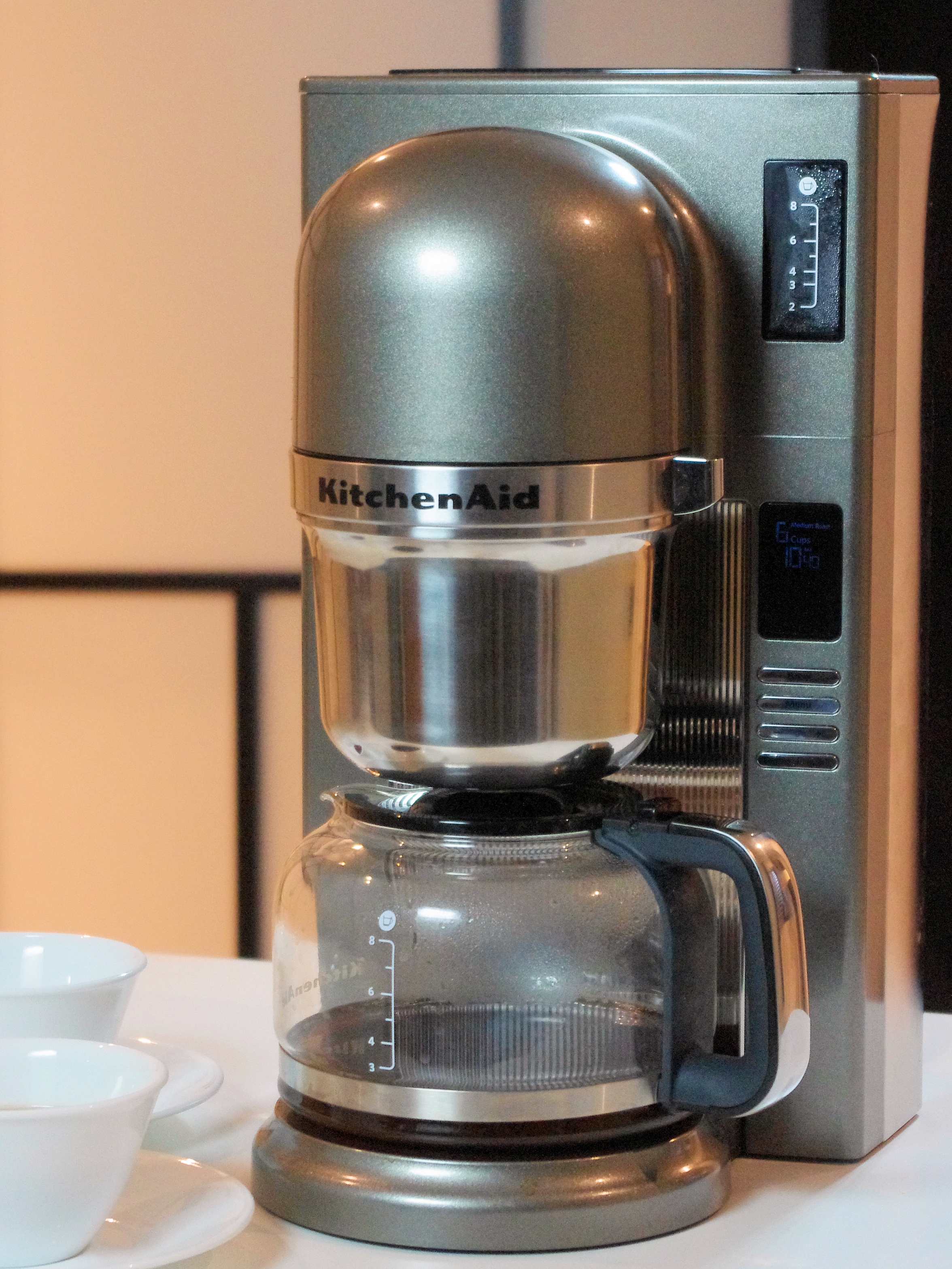
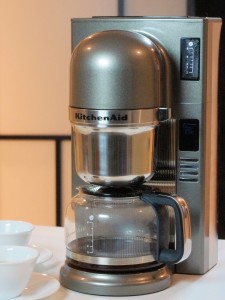 KitchenAid’s new 8-cup automatic drip Coffeemaker is proof that appliance manufacturers now take coffee making parameters as seriously as they do any culinary art. KitchenAid has long been a coffee innovator, with high build quality and within reasonable price points. This new model has literally been years in the making.
I visited them during summer 2012, during which time their four person design team held a therapy session, where I lay back and told them everything missing from most coffeemakers. Just kidding about that part, but suffice it to say, I left feeling unburdened and they went to work building it.
Sure enough, they brought it to this year’s CoffeeCon San Francisco and Los Angeles events. I recall making a beeline to taste a cup. It was good enough that I requested a model for my long-term at-home tests, from which I made review judgments.
This KitchenAid model has several important features:
• Pre-infusion stage. It dribbles a small amount of water, pauses to allow ultra fresh coffee grounds to get wet and exhale their carbon dioxide.
• Intermittent brewing throughout the brewing process, just like you instinctively do using a manual drip coffeemaker. We’ll talk more about this in in a moment.
• Two brewing temperatures. A higher one is just over 200°F, and optimized for lighter roasted (most Third Wave) coffees. The second, lower temperature setting stays under 200°F and is optimized for darker roast coffees. It’s up to you of course, as it’s so cutting edge that there’s hardly consensus on this subject. Suffice it to say, it’s amazing to see a big brand acknowledging the standards and then going a step further by offering you a choice of two brewing temperatures within those standards. Again, this is sophistication on par with manual brewing geeks.
• Perhaps the biggest news is that the KitchenAid meets SCAA (Specialty Coffee Association of America) brewing guidelines, which are stringent. This means a temperature spec (range: 196°-2015°F), within the given drip time spec of 4-6 minutes.
• Cup number setting. This at least promises to be an attempt to prefigure brewing algorithms so you and I don’t have to. More later, but this just might be their most important feature – if it does what it I think it promises.
First, let’s get this out of the way at the start – most so-called automatic drip brewers are one size brewers that are, by modern standards, not very automatic. If you make a full batch, they do well, maybe even very good, but most coffee enthusiasts eventually discover a manual coffee maker makes better coffee, since you have to figure out each parameter. But still, there’s a need for an automatic maker, because everyone, myself included has something else to do other than make coffee. It’s easy to operate. Just choose your cup setting. I had to get used to it, but the first thing you must do is select your desired cup batch size, but pressing plus/minus buttons. Then press whether you want light or dark roast (higher or lower brew temperature). Then hit brew and you’re ready in ten minutes, no matter what batch size.
How did it do in my tests?
Pre-infusion – The KitchenAid does really do this, but it’s still a best guess. As everyone who brews with manual drip brewers knows, this time varies depending upon how fresh your coffee is. KitchenAid designers chose a reasonable pause. It won’t please everyone, but in my tests, it did a good job of allowing most grounds to rise and fall, and then repeating this drip, pause, drip sequence throughout. Only at the 8-cup setting using extremely fresh roasted and freshly ground coffee did I get any foaming that left residue at the top of the brew basket (near showerhead). Most times it was not a problem.
Intermittent brewing – Part of the benefit of continuing to drip, pause and drip throughout the brewing is let all the water drip through before pouring more water onto the grounds. It seems to achieve a better, more thorough extraction. The KitchenAid did not disappoint. I’m sure there are some that will say their manual drip pours are better still, but for many, this brewer will deliver everything they want from their coffee.
Brewing temperature – Here KitchenAid has done itself proud. Its brewing temperature stability is as good or better than most manual drip, especially if you’re using a traditional kettle. If you’re using a kettle with settable temperature, the KitchenAid still matches or exceeds it, but the difference might be unnoticeable. Still, kudos for the two temperature choices and stability.
Cup setting – Many don’t realize that every automatic drip coffeemaker is optimized in contact time for one size batch. Larger batches will take too long, resulting in bitterness/excess strength; smaller batches mean faster (too fast) contact times and resulting weaker brew. This is simple math. If you baked a half batch of cookies and shortened or lengthened baking times, you wouldn’t expect them to taste right, would you? All drip makers, even manual ones have this challenge. KitchenAid seems to do some adjusting of the drip rate inside to accommodate the changing times, so it lessens it. I’d say they’ve make it work overall. The batches I made between four and eight cups were all between four and six minutes in overall contact time (this spec does not/should not count the time the water is heating with no contact). At the two cup setting, the contact time was not long enough. Keep in mind the cup quality may vary between 4 and 6 minutes contact time, but overall I was satisfied.
There are little tweaks you can try such as grinding a notch finer for fewer cups, or simply upping your grounds to water ratios a gram or two. I’ll leave it to others to explore these options. I settled on 6 cups for most of my tests over a month’s use and found it delivered excellent coffee at all settings between 5 and 8 cups, coffee on par overall with my manual drip brewers.
A couple of extra notations:
• The KitchenAid coffeemaker’s sound is quieter than most other automatic drip coffeemakers and its sound is subjectively nicer.
• KitchenAid is to be commended for offering detailed grounds to cup measuring recipes in their well-written instruction book.
• The water input at the KitchenAid’s top is too narrow for my tastes. I occasionally spilled water while filling it. Maybe it’s just me.
• I routinely filled the water tank exactly to the intended batch cups mark, and found the resulting brew on the carafe at brewing’s end was frequently less. I realize this may be caused by steam loss, but I found it works better to always overfill above the water mark.
Here are a few taste test highlights: I was fortunate to pick up a sample of Martin Diedrich’s Kean Coffee at CoffeeCon L.A. It was a slightly darker roast than most Third Wave roasts, and, (gasp) in my opinion, the better for it. It really shined, especially with using the lower (but still SCAA-approved) temperature setting. This kind of coffee really has that chocolate taste (cliché though it seems) and that temperature just seemed to highlight it.
Another treat was Counter Culture’s latest Ethoipian in a new package. This one really called for the higher temperature, but fully matched my expectations, with a fruitiness and acidity this coffee brewer brought forth in all its glory.
A surprise hit of CoffeeCon LA’s roasts was Temple Coffee’s Panama Geisha. Oh my Lord! What a coffee!! I did two batches concurrently. It was so good I went past my limit. The high temperature was my preference, but it did splendidly (albeit differently) in each. Note: I found a perfect formula for me was to make six cups, using 50 weighed grams of beans, medium-fine grind. The slightly less than full batch allowed even the freshest coffees to brew properly, and gave us a perfect way for Pat, I and a friend each have a couple of cups each.
The KitchenAid 8-cup is highly recommended.
by Coffee Kevin | Jan 11, 2015 |

I saw a video clip purporting to fix coffee problems online this morning. I have a few thoughts about it. Of course, the problems depicted are genuine, well most of them. But are their fixes good, effective ones? Here’s my feedback.
1. You Pour Out Leftover Coffee – Freeze Your Old Coffee in an Ice Tray – The concept of freezing coffee to make ice cubes is genuine, and I’ve been recommending it myself for years. When it’s old, however, it’s no longer a good idea. If the coffee is more than a few minutes old, and it’s been either on a warming plate, or in a thermal carafe, don’t do it. If it’s been in an unheated open vessel, and it’s been allowed to cool naturally, great – do it. As far as adding milk and instant latte powder to it later, um, I wouldn’t. But, that’s just me.
2. You power through bitter coffee – Instead they recommend adding a pinch of salt to deaden your taste buds. This is akin to taking off your glasses when you rent a bad video. Why watch it, as I’d say why drink coffee if it doesn’t taste good. The fix for bad coffee is to learn to make it better. As far as the salt solution, wine merchants have known this for years, which is why they feature cheese at tastings. I lost a lot of respect for Alton Brown, who recommended this. Even his nerdy looks couldn’t save him in my mind after this cooking expert recommended a way to deaden your taste buds while tasting.
3. You drown your coffee in sugary flavoring – Instead grind in some natural flavor. Cinnamon, orange rind. I fail to see a philosophical distinction to this fix – what was the problem again? Hmm. Oh, if you want to add flavorings as a culinary experiment, there’s nothing wrong with ito of course. But tossing anything, but coffee, into a coffee grinder taints it forever. That’s a high price to pay, for you and everyone else. So, just so you know there’s no going back after this, truly.
4. You add cold milk to coffee – Then they show a 30 second shake/microwave. Good one, actually. Kudos, although part of the reason people add cream/milk at all to coffee is to lower its temperature to increase taste, to go from scalding the taste buds to being its most savory drinking temperature. Otherwise, rather good.
5. You drink old coffee – Use two old foam cups to track when coffee was made. Ok. Not sure why two are needed. They also show a Mister Coffee machine I tested that’s coffee was what I’d label as “out of service” when it was fresh made, but that’s another article.
I think one or two of these might be helpful. Here’s my list:
1. Learn to brew better coffee. Is your coffee fresh? The water good? The coffee maker clean?
2. Learn the brewing parameters: 196°-205°F water. Contact time between 4-6 minutes.
3. Toss our remaining coffee after 30 minutes. If you are doing this too often, replace the brewer with one that makes what you consume within 30 minutes.
4. Buy coffee that tastes like the flavor you wish to drink. Buy it from a place that samples. You’ll be surprised that many of the world’s coffees have different flavors due to their geography, climate and agricultural care and feeding. How they are roasted makes a huge difference.
5. Choose a brewer that makes coffee the way you like it. A Hario manual drip and a French press are both good methods, but differ vastly in their output in your cup. Even a casual drinker would easily tell the difference.
Instead of fixing bad coffee, I propose making and drinking only good coffee. It’s not that hard.
by Coffee Kevin | Jan 2, 2015 |
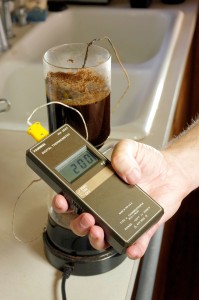 I realize this article will be read mostly by coffee enthusiasts already so involved in brewing that they likely have their own views regarding brewing, and its three most important variables: time, temperature and grind particle size. But, lately there’s been dissention over what for many years appeared to be consensus among the trade. As brewing as an art and craft (hence my book’s title) has developed, there are those who question the basics.
Questioning the basics is, I think, a good thing. Anyone who’s been in family counseling knows it’s a healthy thing to revisit how you divide labor. When it comes to processes, it’s a good thing to reconsider the variables. My observation is that coffee brewing is still being analyzed. Don’t forget that as roasts, types of beans, brewing methods and consumer tastes change, it’s a good idea to do a few experiments. If they confirm the basic parameters, so be it. But, they may not, and why keep doing something wrong?
Historically, much coffee was boiled. I can think of all kinds of reasons for this: pre-chlorination food safety, ease – the bubbles tell you the water’s ready, and thrift – the cheapest way to maximize extraction strength is to use the highest temperature.
The Coffee Development Group, or was it the Pan-American Coffee Council – some predecessor to the Specialty Coffee Association of America (SCAA), did extensive testing, using food experts, not just coffee folks, which resulted in the standards that have been in place for many years.
They include:
• Grind size specifications, basically finer for short extraction times, coarser for longer ones. The current challenge with enthusiasts likely to grind at home, is how to confirm this. It used to be written right on a coffee can.
• Brewing Temperature – It’s easy to tell consumers: “Under Boiling”. Everyone seems to get that now. The last percolator I came in contact was in my late Aunt’s estate sale. BTW, 195°-205°F just tightened to 196°-205°. The extra degree may or may not matter to you, but according to my little birds, the US and European specialty coffee groups wanted to share the same standards for a variety of reasons.
• Contact time – In my observation, this is the one most difficult to control, partly because it’s so difficult to measure, especially in intermittent drip methods. Ever tried?
Recently, I’ve run into a number of enthusiasts, baristas, brewer designers, who complain like music composition students do about tonal scales. Recently, I was sitting in the office of one of the most influential big-coffee business owners, who many would say personifies the word establishment and he told me he believes 200°F is too high a brewing temperature. I’m sympathetic. After all, what kind of thinker would I be if I didn’t like to challenge rules? “Question Authority” – That’s my bumper sticker!
But, I’m here to re-commit CoffeeCompanion to following the rules, at least for now. We need some kind of reference point, or a dialogue is useless. The fact is that a great number of culinary experts were consulted in creating the standards. These folks had taste buds. This wasn’t a casual industry lock down for convenience.
I will always challenge the established rules. I will also follow the standards and use them for my tests. I may expand my tests in certain instances but I will always strive to identify those instances.
Meanwhile, I urge those of you who are doing your own home experiments, playing with brewing parameters to customize your methods to your individual tastes, a worthy pursuit even within the parameters, to start off following the standards. If you decide your Chemex or Aeropress tastes milder, better straight (minus cream or sweetener) when brewed at 180°F, no one is going to take the children from your home.
But, as my music theory teacher said to us in college, “Learn the rules so they can be broken by design, not ignorance.”
We are living in a golden age of brewing. There are all kinds of new brewers, the re-discovery of old ones. The profession of barista confirms that the industry gets that how its coffee is created in a coffee establishment makes a difference. Remember: Wine tastings don’t need bartenders, but coffee tastings need baristas.
CoffeeCon, my ‘lil ol’ coffee show is great fun, but I have an agenda as plain as Karl Marx at a school board meeting. I want consumers to discover coffee as a culinary art and invest the same passion they do into cooking into brewing their coffee. Anyone can do a coffee tasting. We are a coffee university.
So, just FYI, I will keep taking any coffeemaker’s temperature, use a stopwatch to check how long it subjects your (ever-increasing-in-cost) ground coffee to hot water, and play with grind and include those results in my reports.
by Coffee Kevin | Nov 27, 2014 |
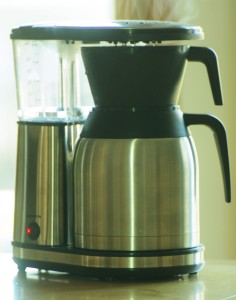
Several years ago, I was attending an SCAA event. Nancy Bloostein, of Oren’s Daily Roast nudged me and suggested I take a look at some new Melitta coffee makers. I ran (literally) over to see what appeared to be Technivorm knock-offs. They were labeled Melitta, but I was then told that they would appear on the marketplace soon under a new name, Bonavita. According to what I was told, Melitta licenses their nameplate to Hamilton Beach in the US. Therefore, although these were Melitta conceived and designed, no mention of Melitta would appear in the US market brewers.
Fast forward to 2014, Bonavita is now a treasured brand. What seems a simple proposition to make an excellent brewer priced to the average consumer, has long eluded most appliance brands. Even though it seems simple, apparently it is not. You need a smart design, one that gets the water almost-instantly hot, a spray heat that evenly disperses that hot water over the grounds, achieving even distribution, and gets the grounds thoroughly soaked, and gets all this done, start-to-finish, within 6 minutes.
So revolutionary was the Bonavita concept that it currently is the leading automatic drip coffeemaker. Bunn, Technivorm, Bodum, KitchenAid and Behmor all have fairly comparable brewers that compete, but somehow the Bonavita just seems to have an edge, when it comes to hitting the consumer sweet spot of price, performance, quality and ease. Remember if it isn’t easy, it isn’t automatic, is it?
So far, I’ve compared the Bonavita only to other automatic drip brewers. But as Third Wave Coffee has emerged, the bar has been lifted, as more consumers who use a Chemex, Hario or other manual brewer for their weekend or other special brews, want an automatic drip brewer to reach higher to match these inherently customized devices.
One interesting change: Bonavita has moved from the Melitta V-filter to the US-cupcake filter. Does this mean that Melitta no longer designs this brewer? Inquiring minds ponder this. Although I have found differences such as filter types to generally be outweighed by other factors, I philosophically agree with the reasoning that the cupcake filter spreads the grounds extraction task more evenly at the bottom, so I consider it a good (if shocking) move. I also applaud their resistance of the metal filter, which I consider overall inferior to paper in its ability to separate flavor compounds from grounds.
There are two things the Bonavita did not do as compared to manual drip. One is vary the brewing temperature. The other is match the intermittent pour that we use when we brew manually, which is especially important near the brew’s beginning when using fresh roasted coffee.
The new Bonavita offers only one brewing temperature, but they have gone out of their way to include a pre-infusion stage, which sprinkles ideally hot water over the grounds, then shuts down in order to allow a freshly-roasted, freshly-ground coffee to rise and fall appropriately, before continuously running hot water over the grounds.
So, how does it perform?
The new Bonavita handily meets every specification of an automatic drip coffeemaker, as did its predecessor. The brewing temperature is within the 196-205°F range. The brewing cycle (without pre infusion) is under 6 minutes. Pre-infusion adds around 30 seconds, as it should.
The ability to match intermittent brewing with your (or your barista’s) best efforts keeping pace with the water’s drip rate during brewing is not able to track as well as manual brewing, in my opinion the goal. Nor is it with the Behmor Brazen or any other yet-invented automatic brewer. What I can say, is I never had an overflow, no matter how fresh the grounds. I inserted a Chemex underneath the Bonavita, which is to be fair, not anything they suggest or offer to accommodate. The brew drip rate was simply too fast, even in the pre-infusion setting. But, this is more about how fast consumer expectations are rising, than any shortcoming on this brewer’s part.
What’s left? Well, the Behmor Brazen offers adjustable brewing temperatures and adjustable pre-infusion time settings. Will this matter to you? I cannot answer that, but I can say the Bonavita does a very, acceptable job with several coffees I’ve been using since it arrived one month ago.
Temple Roasters Panama Don Pepe Boquete Geisha is a light roasted delicate coffee that showed its full colors when brewed in the Bonavita. I was able to closely match what I could achieve in a Chemex.
Kean Coffee’s Nicaragua La Prometido is roasted slightly darker, or is it just the Diedrich roasting imprint? Not sure, but this stellar varietal comes through with its notes intact. This kind of roast is not for the timid (roaster that is). To catch it just before it starts to go caramel on us, is really a test of roasting skill. I was able to taste the full resolution of the coffee with the Bonavita.
Conclusion: The Bonavita took a good idea and made it better. There is not one thing I noted where I said, “Oh, I wish they hadn’t changed that”. Bravo!

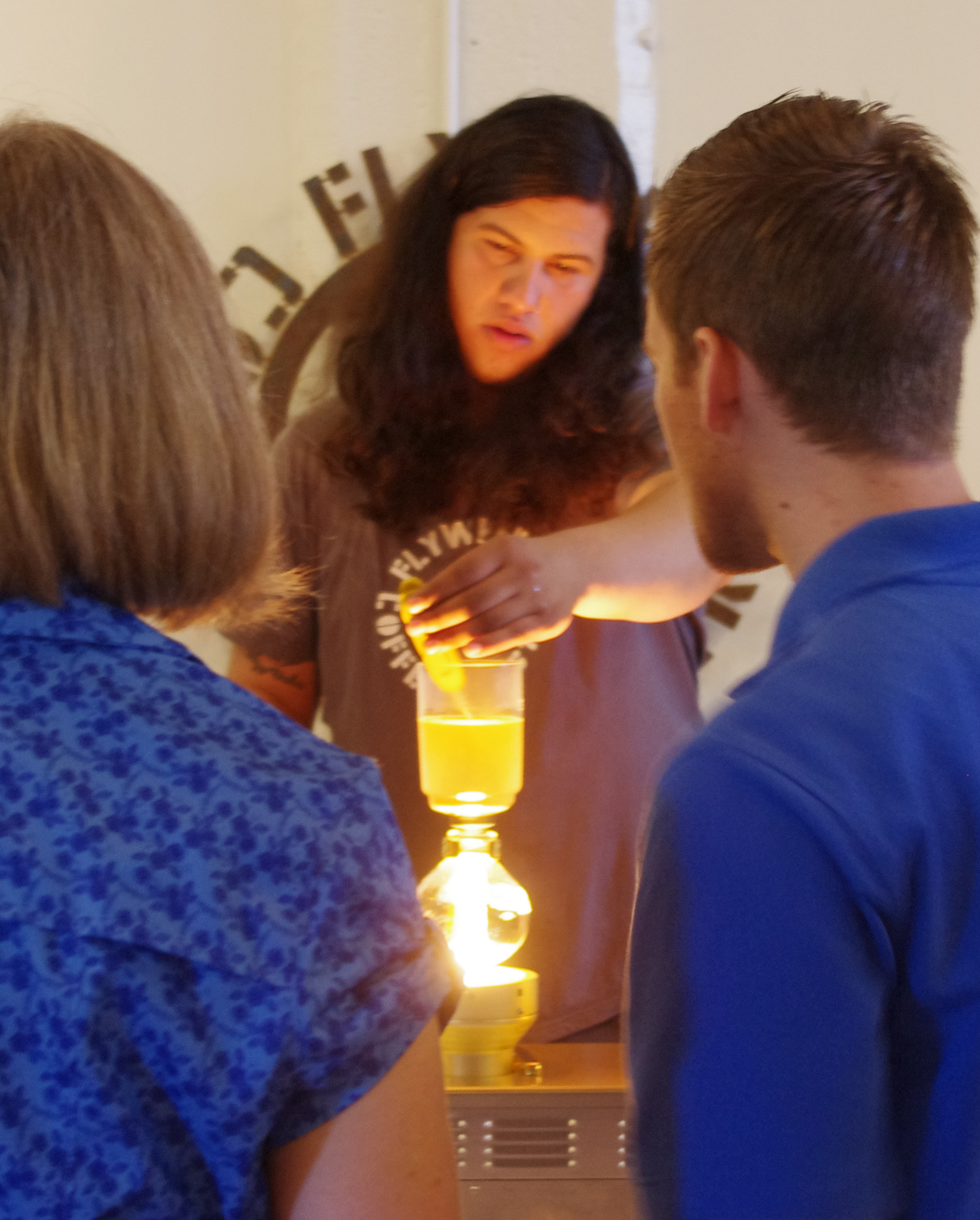 The Hario Syphon is perhaps the ultimate quality siphon, also long-known as a vacuum coffee maker. The Syphon works on the principal that near-boiling hot water in an enclosed lower vessel releases steam that expands, forces the hot water up through a tube into the upper bowl, where it is inherently the right temperature to brew coffee. As long as the lower bowl is kept heated, the water will stay up there, brewing coffee. The bubbling below causes the water in the upper bowl’s water to agitate the grounds, facilitating the extraction process. When the operator decides enough is enough, she simply removes all heat below and within about a minute the cooling and contracting vapors below cause the lower bowl to suck (hence the word vacuum) the finished brew back down into the lower bowl. Oh, did I mention there is always a filter between the two bowls? Haha, that alone is worth a patent. Siphons vary in the heating method (earliest samples were flame powered) material (glass is original and common, metal durable but no theater, plastic combines both benefits but it’s plastic) and filter type. The filter type is likely the most important of the variables to affect taste, and I’ll go into that later.
 Should history ever agree to repeat itself in a different order, I’ve long felt the siphon would have been the ideal brewer to replace drip. After all, the siphon fixes the following drip issues:
 You get:
 So, recommended or not? I will never knowingly write anything but the truth in this blog. While I acknowledge that this brewer still requires more active concentration from the end user, I also know it makes some of the best coffee I’ve yet tasted. No getting around it. For ultra-fresh coffee, very good quality coffee, roasted to its more flavorful degree, the Hario Syphon does a unique job. Carefully used, you can get a very thorough extraction, full of fruit and complexity. You truly feel you are tasting deep into the coffee. So, yes, highly recommended, with the caveat that you must become part of the task of brewing it. It is not yet truly automated in this product, and if used in a way that is automated, you are, in my opinion, giving up flavor in exchange. How Do I Use It? There are lots of ways to use a siphon or vacuum brewer. Here’s my personal method.
 Some people use fine grind for vacuum. I used to, but lately I’ve found a coarser grind to work best. Siphons can use any grind as grind really does little to affect contact time. Of course surface area exposure affects the taste strength; that remains. Using the metal filter I find the coarse grind reduces particles in your cup. I use close to what I’d use for regular drip.